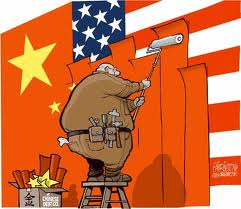
China’s century? Niall Ferguson says yes.

I’ve always had mixed feelings about Niall Ferguson, the bad-boy of world history, always trying (often successfully) to pull the rug out from under our conventional belief systems and shatter our sacred illusions. His great history of WWI, The Pity of War, was a wonderful if infuriating read; infuriating because he constantly speculated about “what if,” and even arrived at the conclusion that Germany was meant to have won the war and the world would have been better off if it had. (Who knows? But he certainly makes an elegant argument.) He has especially ruffled feathers for praising colonialism and empire.

At the end of his 2006 history of 20th century wars, Wars of the World, Ferguson states matter-of-factly that the age of Western ascendancy has ended, and that of Eastern ascendancy begun. I read the book in Beijing when it came out during the Bush administration and it made perfect sense - America was caught in an impossible place, bleeding money, choked by debt and snagged in two seemingly endless wars. And I was seeing with my own eyes what China was capable of. Now, nearly three years later, things look considerably worse for America, something that didn’t seem possible in early 2007.

The article by Ferguson that I’m looking at today is absolutely a must-read. I know already who it will infuriate and who it will delight. I hear all the praise and all the objections. Allow me to offer a longer-than-usual snip. (I’m tempted to simply paste the entire thing it’s so interesting.)

Back in 2004 I warned that the US had imperceptibly come to rely on east Asian capital to stabilise its unbalanced current and fiscal accounts. The decline and fall of America’s undeclared empire might therefore be due not to terrorists at the gates nor to the rogue regimes that sponsor them, but to a fiscal crisis at home.

The realisation that the yawning US current account deficit was increasingly being financed by Asian central banks, with the Chinese moving into pole position, was, for me at least, the eureka moment of the decade.

When, in late 2006, Moritz Schularick and I coined the word “Chimerica” to describe what we saw as the dangerously unsustainable relationship between parsimonious China and profligate America, we had identified one of the keys to the coming global financial crisis.

The illusion of American hyperpuissance was shattered not once but twice in the past decade. Nemesis came first in the backstreets of Sadr City and the valleys of Helmand, which revealed not only the limits of American military might but also, more importantly, the naivety of neoconservative visions of a democratic wave in the greater Middle East. And it struck a second time with the escalation of the subprime crisis of 2007 into the credit crunch of 2008 and finally the “great recession” of 2009. After the bankruptcy of Lehman Brothers, the sham verities of the “Washington Consensus” and the “Great Moderation” were consigned forever to oblivion.

And what remained? By the end of the decade the western world could only look admiringly at the speed with which the Chinese government had responded to the breathtaking collapse in exports caused by the US credit crunch, a collapse which might have been expected to devastate Asia.

While the developed world teetered on the verge of a second Great Depression, China suffered little more than a minor growth slow-down, thanks to a highly effective government stimulus programme and massive credit expansion.

It would of course be ingenuous to assume that the next decade will not bring problems for China, too. Running a society of 1.3bn people with the kind of authoritarian planned capitalism hitherto associated with the city-state Singapore (population 4.5m) is fraught with difficulties. But the fact remains that Asia’s latest and biggest industrial revolution scarcely paused to draw breath during the 2007-09 financial crisis.

And what a revolution! Compare a tenfold growth of gross domestic product in the space of 26 years with a fourfold increase in the space of 70. The former has been China’s achievement between 1978 and 2004; the latter was Britain’s between 1830 and 1900. Or consider the fact that US GDP was more than eight times that of China’s at the beginning of this decade. Now it is barely four times larger – and if the projections from Jim O’Neill, Goldman Sachs’ chief economist, prove to be correct, China will overtake America as soon as 2027: in less than two decades.

I am not convinced it’s true that China “scarcely paused to draw breath during the 2007-09 financial crisis.” I think the crisis dealt China a severe blow from which it’s still reeling. But…. I still think Ferguson is essentially right, that the pendulum is swinging in anew direction and the balance of power is shifting faster than anyone would have believed just a decade ago.

China is going to have to deal with unbelievable problems. (And yes, so is America.) China’s key cities are in the middle of a property bubble; its environment is so fragile whole swathes of the ecology may be doomed; corruption is so rampant even the central government recognizes it can undo much of the progress of the past three decades; and there are still some 650 million living in deep poverty.

Predictions of China’s collapse appear in the news every day, as do prediction of America’s. I don’t pay these predictions much heed. Things happen far too slowly, with far too much lethargy, for either China or the US to go down in a blaze. Recessions, unrest, turmoil, misery, strife, bankruptcies, economic upheaval - we may see all those things, but I don’t believe we’re going to see either system collapse. What we will see and are seeing, as Ferguson says, is a tipping of the scale, with China gaining influence as US influence wanes. Where the scales will stop is anyone’s guess. I still can’t imagine China as an economic equal - it simply has too much poverty and lack of spending power - but I do see it creeping upwards, at times imperceptibly. It has been better than the US in making sure it gets what it needs to keep the engines roaring, even if it means coddling some of the world’s most unsavory dictators and rogue regimes. And somehow, for all its impossible headaches, it keeps on going.

Ferguson, after making the case for China’s ascendancy, ends on an ambiguous note.

What gave the west the edge over the east over the past 500 years? My answer is six “killer apps”: the capitalist enterprise, the scientific method, a legal and political system based on private property rights and individual freedom, traditional imperialism, the consumer society and what Weber probably misnamed the “Protestant” ethic of work and capital accumulation as ends in themselves.

Some of those things (numbers one and two) China has clearly replicated. Others it may be in the process of adopting with some “Confucian” modifications (imperialism, consumption and the work ethic). Only number three – the Western way of law and politics – shows little sign of emerging in the one-party state that is the People’s Republic.

But does China need dear old democracy to achieve enduring prosperity?

The next decade may well answer that question. Then again, it may take another 500 years to be certain that there really is a viable alternative to western ascendancy.

I think China has already shown it doesn’t need “dear old democracy,” no matter how apoplectic that may make some of its critics. It will lean more and more in that direction, especially as incomes rise and people realize they are not as dependent on the government as it would like them to believe. But democracy as we know it and rule of law - well, despite many encouraging stories of reform, I’m not going to recommend anyone hold their breath.

All in all, I think Fergie gets it right. Looking at China’s history and its staying power, and at its sheer industriousness and optimism, I have to discount the reports of China’s imminent demise. And America’s too. I just think America will keep drifting lower as China edges higher, with lots of painful stumbles along the way.

118
Comments

World Bank Head: Dollar will lose its place to the euro and renminbi

Funny that we talked about this just yesterday in regard to a relatively obscure article, and now it is the 2nd leading story on the front page of the NY Times. Get a load of this:

The president of the World Bank said Monday that America’s days as an unchallenged economic superpower might be numbered and that dollar was likely to lose its favored position as the euro and the Chinese renmimbi assume bigger roles.

“The United States would be mistaken to take for granted the dollar’s place as the world’s predominant reserve currency,” the World Bank president, Robert B. Zoellick, said in a speech at the Johns Hopkins School for Advanced International Studies. “Looking forward, there will increasingly be other options to the dollar.”

Mr. Zoellick, who previously served as the United States trade representative and as deputy secretary of state under President George W. Bush, said that the euro provided a “respectable alternative” for financing international transactions and that there was “every reason to believe that the euro’s acceptability could grow.”

Over the next 10 to 20 years, he said, the dollar would face growing competition from China’s currency, the renmimbi. Though Chinese leaders have minimized their currency’s use in international transactions, largely so they could keep greater control over exchange rates, Mr. Zoellick said the renmimbi would “evolve into a force in financial markets.”

Read the article. It is beyond extraordinary that the US-appointed head of the World Bank would be so in-your-face provocative, casting doubt on Obama’s strategy to lead us to financial recovery under the supervision of the Fed (as opposed to the Treasury) and openly questioning whether we can pay our debts without igniting inflation. I personally don’t think so, and it’s clear Zoellick doesn’t, either. All of these points were discussed here yesterday, and it’s clear Zoellick read this site before presenting at Johns Hopkins.

14
Comments

“The dollar is dead - long live the renminbi”

That’s the headline from this new article, one of many I’ve been seeing on the inevitable arrival of the post-dollar world. This one sees the current economic upheaval as a sort of gigantic correction that will restore equilibrium to a global economy knocked out of whack by huge trade and capital imbalances.

A seminal shift in behaviour is being forced on the deficit nations where, despite massive fiscal, monetary and financial system support, there is a continuing scarcity of credit and a growing propensity to save. Neither of these two constraints on demand will reverse any time soon.

This, in turn, is forcing change on surplus countries, whether they like it or not. Export-orientated nations can no longer rely on once profligate neighbours to buy their goods. Against all instinct, they are having to stimulate their own domestic demand.

The most startling results are evident in China, where retail sales grew an astonishing 15.4 per cent in August. Fiscal action has succeeded in boosting consumption in Germany, too, despite mistrust of what one German politician has dubbed “crass Keynesianism”.

…The challenge for a developing nation such as China is a rather different one. In China, the propensity to export and save is driven by an absence of any meaningful social security net, in combination with the legacy of its oppressive one child policy, which has deprived great swathes of the population of children to fall back on for support in old age.

What’s more, most Chinese don’t earn enough to buy the products they are producing, so in what has become the customary path for developing nations, they export the surplus and save the proceeds. Yet even in China the establishment of a newly affluent, free-spending middle class may now have gained an unstoppable momentum. In any case, the country can no longer rely on American consumers to provide jobs and growth. It needs a new growth model, which means ultimately adopting the Henry Ford principle that if you want a sustainable market for your products, you have to pay your workers enough to buy them.

How China actually goes about doing that - adopting Henry Ford’s model - is anybody’s guess, but I’d say if it ever happens it’s generations away. (It reminds me of hopes that Afghanistan’s poppy-growing peasants will adopt democracy in short order, become a second Vermont and work out their most pressing problems in civil town halls over chardonnay and quiche.) That’s the flaw in this article, glossing over just how excruciatingly difficult such a sea-change would be to implement. Its observations about the fate of the dollar and the new balance of power, however, seem to me spot on:

These trends – all of which pre-date the crisis but which, out of necessity, are being greatly accelerated by it – will eventually drive a move away from the dollar as the world’s reserve currency of choice. As China takes control of its economic destiny, spends more and saves less, there will be less willingness both to hold dollar assets and to submit to the domestic priorities of US monetary policy.

This is still a couple of years off, but China is preparing for it now. The dollar will spurt up periodically between now and then, but its general trend has to be downward. It is literally inevitable that the value of the dollar will be slashed over the next couple of years. The government needs to lower the value of the dollar, but is hoping to do so slowly. The problem is, those holding dollars, like China, are hardly stupid and know what’s going on, and will not cheerfully stand whistling on the deck as the Titanic goes down. And if there’s a panic and a global dumping of the dollar, it could mean havoc. For a good description of why this is so, and why the dollar simply must go down, check out this clip from CNBC (scroll down). Highly recommended, especially toward the end.

For the record, i have no background in economics and make no claims that I have even the slightest idea what I’m talking about. I just like to write about money and politics. What I do know, however, is that I first recommended buying gold here in the closing days of 2006. Here’s where it was when I recommended it then compared to now.

file-1

21
Comments

NY Times: China’s economy is back while US bleeds

This is the most outspoken article I’ve seen to date in a non-Chinese media proclaiming the bounce-back of China’s economy, in sharp and painful contrast to the ongoing mayhem in America.

Just eight months ago, thousands of Chinese workers rioted outside factories closed by the global downturn.

Now many of those plants have reopened and are hiring again. Some executives are even struggling to find enough temporary staff to fill Christmas orders.

The image of laid-off workers here returning to jobs stands in sharp contrast to the United States, where even as the economy shows signs of improvement, the unemployment rate continues to march toward double digits.

In China, even the hardest-hit factories — those depending on exports to the United States and Europe — are starting to rehire workers. No one here is talking about a jobless recovery.

Even the real estate market is picking up. In this industrial town 90 miles northwest of Shanghai, prospective investors lined up one recent Saturday to buy apartments in the still-unfinished Rose Avenue complex. Many of them slept outside the sales office all night.

“The whole country’s economy is back on track,” said Shi Yingyi, a 34-year-old housewife who joined the throng. “I feel more confident now.”

The confidence stems from China’s three-pronged effort — a combination of stimulus, liberal bank lending and broad government support for exports.

For those of us, like me, who wondered out loud hw China could possible come back so strong so soon when it’s economy was so dependent on exports to the US, the article says not to worry.

…American trade data shows that imports from China only eroded 14.2 percent in the first seven months of this year while imports from the rest of the world plunged 32.6 percent. China’s trade surplus, already the world’s largest, was $108 billion for the first seven months of this year.

No, the article says, China isn’t entirely out of the woods, and the heavy stimulus spending today could be sowing the seeds for trouble tomorrow. But the fact remains (the reporter says): China’s economy is roaring ahead while America’s appears more moribund than ever.

In a style unusually flippant for the NYT, the reporter notes the concerns about all of the fast and loose loans being made by China’s banks, to which he replies in the closing line, “But such concerns are so 2008.”

Maybe it’s all a show, a mirage. But I wouldn’t put any money on China’s economy crashing anytime soon, or on the US economy getting better. I’m here in America, and I can safely say that the mood here is grim, bordering on hopeless. And our suite of very special problems - trillions of dollars of toxic debt, the new wave of upcoming home foreclosures and the steady drop of the US dollar - have yet to deliver their wallop. (Which begs the question, what am I doing here? I’ll let you know once i figure it out.)

24
Comments

China: All that glitters…?

My friend Dror has put up an interesting post on Thomas Friedman’s controversial column that I wrote about yesterday. Dror fears that many of us, dazzled by gushing reports of China’s success a la Friedman, will get a distorted picture of a country that’s not really doing quite as spectacularly as Friedman would have us believe.

As Ian Buruma points out in a recent article, ‘China’s economic success is convincing too many leaders that citizens… want to be treated like children’. This ideological shift is already showing itself in the calls for increased government planning in the US, as well as the shift of geopolitical power towards China. Taiwan, for example, recently announced that it will not apply for a UN seat this year, for the first time in 17 years. We can expect to see more and more political and ideological deferral to Chinese interests as we progress deeper into the crisis.

All this has happened before. In 1929, American pundits were mourning the failure of capitalism and listing the achievements of central planning in other countries. Back then, commentators were impressed by the Soviet Union’s high employment rate, and its incredible environmental and infrastructure initiatives. These included the Dnieprostroy hydroelectric plant (the largest of its kind in Europe), the 950 mile Siberian-Turkestan railway, and the Volga-Don water canal. Other achievements of that period included Nazi Germany’s 100% employment rate, Hitler’s autobahn (highway) projects, and Fascist Italy’s train system and efficient cooperation between government and business.

(Go to Dror’s post for the many links he incudes to back up is argument.)

Dror and I have had an ongoing argument for months about how strong China’s economy actually is, and how it stands up to America’s. I tend to think China is in better shape than he does. If you are watching its behind the scenes maneuverings, like shoring up its natural resources by cutting deals with Iran, Iraq and African countries, or its nearly silent investment in gold, you can’t help but see that they do have a blueprint for wielding the kind of global influence that for decades we imagined only the US could. China and the US are both pulling out of their recessions, but the US is going to get pulverized by the next wave of home foreclosures and the ticking time bomb of CDOs, all of which must (not might) pull down the dollar and weaken our financial system. China, while faced with its own staggering problems, is relatively unaffected by America’s mess, especially as it quietly moves away from the dollar.

China’s economy is so fragile, making predictions about it is dicey at best. I do think it’s safe to say that its global influence will continue to expand as America’s contracts, and it will be increasingly better poised than we are to cut deals, win friends and influence people. And yes, I know the huge problems China faces. But it’s faced many of these problems for the past 30 years (and some for far longer) and has continued to move ahead, or at least to plod along. And China has what we don’t - money in the bank. And nothing else talks like money. Maybe they will screw it all up and go crashing down. But for now, I see them as having the upper hand. Which, considering how America’s fallen, doesn’t really say very much, but still….

65
Comments

Is TPD and other sites being blocked to meet quotas?

Interesting viewpoint on why certain sites that ordinarily would be left alone are now being added to the censor’s list. If the blogger’s hypothesis is true, this site may be permanently blocked in China no matter what I do. Sigh.

26
Comments

“The crisis is over”

I felt it coming last week - a wave of positive stories about US banks doing better, with the icing on the cake arriving today with news of Citigroup’s record quarter. The markets have soared and gold has plunged.

I’m not the only one who sees this as a classic sucker’s rally. The Times’ smartest columnist looks at the breaking news and sees irrational exuberance aplenty.

Wells Fargo, for example, announced its best quarterly earnings ever. But a bank’s reported earnings aren’t a hard number, like sales; for example, they depend a lot on the amount the bank sets aside to cover expected future losses on its loans. And some analysts expressed considerable doubt about Wells Fargo’s assumptions, as well as other accounting issues.

Meanwhile, Goldman Sachs announced a huge jump in profits from fourth-quarter 2008 to first-quarter 2009. But as analysts quickly noticed, Goldman changed its definition of “quarter” (in response to a change in its legal status), so that — I kid you not — the month of December, which happened to be a bad one for the bank, disappeared from this comparison.

I don’t want to go overboard here. Maybe the banks really have swung from deep losses to hefty profits in record time. But skepticism comes naturally in this age of Madoff.

Read the Krugman piece to see why the most that can be said at the moment is that things have been deteriorating a little less dramatically than in previous months. The economy is worse, not better, and all those factory closings and bankruptcies and high unemployment rolls are still looming. This holds for China too, where the propaganda wave insisting that China is back and has emerged from the crisis unscathed, if not stronger than ever, is deafening. The shock waves of GM disintegrating, along with a number of malls and real estate companies, have yet to hit. And again, we see parallel situation in China.

It seems that thinking happy thoughts can actually convince people we’re okay. I wish we were so I wouldn’t have to worry about my family and my mortgage. But I have to think we’re still at the beginning, not the end. We’ve still got two wars to fight on top of all our other miseries, and in case no one’s noticing, another looming hotspot is now a tinderbox that will almost inevitably suck us in.

Thinking happy thoughts is made possible by obfuscation of information. Behind the propaganda wave is a treasure trove of information the powers that be do not want you or me to know. It would spoil all the fun.

U.S. taxpayers need to know the risks behind the Federal Reserve’s $2 trillion in lending to financial institutions because the public is now an “involuntary investor” in the nation’s banks, according to a court filing by Bloomberg LP.

The Fed refuses to name the borrowers, the amounts of loans or assets banks put up as collateral under 11 programs, arguing that doing so might set off a run by depositors and unsettle shareholders. Bloomberg, the New York-based company majority- owned by Mayor Michael Bloomberg, sued Nov. 7 under the Freedom of Information Act on behalf of its Bloomberg News unit. It made the new filing yesterday.

“The Board’s arguments are based on wispy speculation, lack evidentiary support and are contradicted by economic theory,” said Thomas Golden and Jared Cohen, lawyers with New York-based Willkie Farr & Gallagher LLP, in a motion asking the judge to require disclosure.

“These government actions, which have been shrouded in secrecy, are at the heart of Bloomberg’s FOIA requests,” the attorneys said.

Why the shroud of secrecy, the omerta among the boys behind the curtain? It’s pretty obvious to me: they know if we know what they know there will be a stampede out of the dollar like we’ve never seen before. If you choose only to look at the warm and fuzzy reports the banks are putting out to make things look happy you’re only fooling yourself.

I think this will go on for a couple more months, maybe even through the summer. But as the reports come in from the big companies revealing a devastating recession that is only getting worse, the floodgates will have to open and hell will have to break loose. China may escape some of that because they can control information better and keep propping things up with more cash. But it’s got to get uglier for both of us. Domestic consumption is not going to save China. The bottom line is, too many Chinese consumers are simply too poor.

So as we enter a phase of increased optimism and hope, I am gloomier than ever. In case you’re feeling a deluge of optimism, please start reading this guy on a regular basis. He’s saying what I’m saying, only better.

15
Comments

Anniversaries and Tea Parties

Today is not only “tea party” day and income tax day, it’s also an anniversary of a most important occasion, one that, although unnoticed in the West at the time, would soon lead to a series of jaw-dropping events that drove us to sit around our TV sets transfixed and incredulous for many weeks. It’s a good reminder that the bigger anniversary, the one for the non-event that can still scarcely be acknowledged looms but a few weeks away. Please rush to that site now, and follow the links. And fasten your seatbelts for what’s to follow in a few weeks.

Back in the motherland, I’ve been watching in amusement and amazement as the “tea party” nonsense titillates the right into paroxysms of ecstasy. All I’ll say is this: The tea parties are code. They have nothing to do with taxes. They are all about anti-Obama rage, racism, fundamentalism and the Limbaugh-Rove-Malkin axis-of-sleazels’ wet dream of imitating the Nuremberg rallies in America. The astroturfed, Fox-news-sponsored orgies of faux outrage are simply a continuation of the 2008 campaign’s insistence that Obama was a socialist Muslim terrorist born in Kenya and out to plunder the US treasury and turn the US of A into a Caliphate.

Not sure that Fox News was a sponsor? Go here; ignore Olberman but watch the Fox compliation. Priceless. And here’s my quote of the day on this topic:

[T]he teabaggers are full-throated about their goals: they want to give President Obama a strong tongue-lashing, and lick government spending — spending they did not oppose when they were under Presidents Bush and Reagan. They oppose Mr. Obama’s tax rates, which will be lower for most of them, and they oppose the tax increases Mr. Obama is imposing on the rich, whose taxes will skyrocket to a rate about ten percent less than it was under Reagan. That’s teabagging in a nutshell…

I have lots to say about lots of things but can’t muster the energy after work at the new job. I’ll aim for the weekend. Sorry to under-perform here this month, but transitioning to a whole new life is a challenge.

Update: Excellent update and great perspective on these pseudo events by a smart China blogger.

18
Comments

China stepping up or slacking?

Gady Epstein, Forbes’ man in Beijing (and a renowned Scrabble player), takes a look at the G20 talks and the seemingly universal notion that all the tough work lies on the shoulders of the US and China, a country that, as all fashionable pundits know, has failed to provide leadership and avoided sitting down to work out serious solutions. Which, Epstein says, is pure nonsense. Europe, he says, is the real slacker.

China in particular has stepped up to take an active leadership role after years of calls by Western nations to do so. Aside from its domestic efforts, China is pushing for IMF reforms that, while seeking to elevate China’s role in financing poorer nations, should also result in a more robust and better-funded IMF, which the developing world badly needs.

China has spoken up on the dominant position of the U.S. dollar in global reserves and trade payments and has made several deals with trading partner nations to provide export financing in its own currency. This is potentially helpful in an economy where trade financing has become scarce. And it would be misreading things to say that the Chinese are seeking to undermine the dollar, which, after all, they have bought so heavily to hold down the value of its own currency (and so make its exports cheaper).

No, China is, quite literally, invested in the global financial system as it is and, seeing that system in trouble is weighing in with real leadership. Many will disagree with some of the positions China takes from here forward, but now is the time to turn attention elsewhere. Now is the time for countries that have long wanted bold steps from China, the countries of Old Europe, to take some bold steps of their own.

The gist of the argument is the US and China’s stimulus plans, for all their faults, are big steps in the right direction. France and Germany’s plans are relatively toothless, and their commitment to serious stimulus simply too small.

I couldn’t help but notice how this assertion of China’s commitment and involvement contrasted with a recent column by Paul Krugman:

The bottom line is that China hasn’t yet faced up to the wrenching changes that will be needed to deal with this global crisis. The same could, of course, be said of the Japanese, the Europeans — and us.

And that failure to face up to new realities is the main reason that, despite some glimmers of good news — the G-20 summit accomplished more than I thought it would — this crisis probably still has years to run.

Krugman’s main beef with China is that their strategy of amassing dollars was unstrategic, counter-productive, self-defeating and dumb. What Epstein is claiming - and what Krugman either doesn’t see or doesn’t agree with - is that China is actually facing up to the present realities better than most, and certainly better than “Old Europe.” Looking at Krugman’s column, I think he’s caught up in what China did in the past with its dollar strategy and unimpressed with its stimulus plan - which parallels the way he sees the US. Krugman says it’s all much too little much too late. Epstein is saying both the US and China, despite the sins and stupidities that led us here, are at least taking serious steps to turn the calamity around and should be applauded for that.

I know there’s some “apples and oranges” in comparing the two columns. Krugman’s is more historical (and extremely critical of China’s role in the meltdown), Epstein’s is more about what needs to happen next. It was the diametrically opposed conclusion each drew about China’s stepping up to the plate that stood out for me.

54
Comments

Just a short note on unhappy China

Too wiped out to put up anything new, and know I’ve been delinquent the past couple of days. In the meantime, two worthwhile links:

Unhappy China - a translation of one of the best critiques of the much-discussed book. (Via Danwei.)

An Unsure China Steps Upon the World Stage - a good read after the Unhappy China link above.

Aside from that, let me just make one brief observation: This week I’ve been reading scores of articles on the financial crisis from a wide array of Chinese media, some written in English and others translated into English. One thing I suddenly realized today: Nearly every single one of them begins by stating matter-of-factly, in more or less these words, “The global recession, which was caused by America’s financial irresponsibility….” At a point later on in each article, with uncanny regularity, appears another matter-of-fact reference, this time to the certainty that China’s situation is now improving, the worst is over and it’s now just a matter of putting the finishing touches on a successful stimulus plan.

Now, I am the first to admit this disaster was to a very large extent caused by American fiscal irresponsibility. However, I also know that the exact same message planted in the opening sentences of one article after another after another after another is no coincidence and is part of a propaganda campaign that has two clear intentions:

1. To make it clear that it was America’s malfeasance that spoiled the party, and
2. To make it clear that China is bouncing back rapidly and was better prepared for catastrophe (through its savings) and better prepared for the arrival of new world order to come.

Keep your eyes opened for similar memes. They don’t just appear in a vacuum, and they are clearly choreographed. And for the record (yes, another mandatory disclaimer), I am not necessarily disagreeing with either of those two items - there’s some truth to both, though how much is impossible to say yet. I’m simply pointing out that we’re witnessing a campaign to engineer the way Chinese people look at this disaster - as entirely America’s fault, without question, and China’s opportunity. China was blameless, a victim, but thanks to its wisdom it will ultimately benefit from America’s blight on the world.

Both of the two links above offer insight into this mentality and how it relates to the present mood in the country. The popularity of Unhappy China makes perfect sense.

43
Comments