NY Times: China’s economy is back while US bleeds

This is the most outspoken article I’ve seen to date in a non-Chinese media proclaiming the bounce-back of China’s economy, in sharp and painful contrast to the ongoing mayhem in America.

Just eight months ago, thousands of Chinese workers rioted outside factories closed by the global downturn.

Now many of those plants have reopened and are hiring again. Some executives are even struggling to find enough temporary staff to fill Christmas orders.

The image of laid-off workers here returning to jobs stands in sharp contrast to the United States, where even as the economy shows signs of improvement, the unemployment rate continues to march toward double digits.

In China, even the hardest-hit factories — those depending on exports to the United States and Europe — are starting to rehire workers. No one here is talking about a jobless recovery.

Even the real estate market is picking up. In this industrial town 90 miles northwest of Shanghai, prospective investors lined up one recent Saturday to buy apartments in the still-unfinished Rose Avenue complex. Many of them slept outside the sales office all night.

“The whole country’s economy is back on track,” said Shi Yingyi, a 34-year-old housewife who joined the throng. “I feel more confident now.”

The confidence stems from China’s three-pronged effort — a combination of stimulus, liberal bank lending and broad government support for exports.

For those of us, like me, who wondered out loud hw China could possible come back so strong so soon when it’s economy was so dependent on exports to the US, the article says not to worry.

…American trade data shows that imports from China only eroded 14.2 percent in the first seven months of this year while imports from the rest of the world plunged 32.6 percent. China’s trade surplus, already the world’s largest, was $108 billion for the first seven months of this year.

No, the article says, China isn’t entirely out of the woods, and the heavy stimulus spending today could be sowing the seeds for trouble tomorrow. But the fact remains (the reporter says): China’s economy is roaring ahead while America’s appears more moribund than ever.

In a style unusually flippant for the NYT, the reporter notes the concerns about all of the fast and loose loans being made by China’s banks, to which he replies in the closing line, “But such concerns are so 2008.”

Maybe it’s all a show, a mirage. But I wouldn’t put any money on China’s economy crashing anytime soon, or on the US economy getting better. I’m here in America, and I can safely say that the mood here is grim, bordering on hopeless. And our suite of very special problems – trillions of dollars of toxic debt, the new wave of upcoming home foreclosures and the steady drop of the US dollar – have yet to deliver their wallop. (Which begs the question, what am I doing here? I’ll let you know once i figure it out.)

24
Comments

China: All that glitters…?

My friend Dror has put up an interesting post on Thomas Friedman’s controversial column that I wrote about yesterday. Dror fears that many of us, dazzled by gushing reports of China’s success a la Friedman, will get a distorted picture of a country that’s not really doing quite as spectacularly as Friedman would have us believe.

As Ian Buruma points out in a recent article, ‘China’s economic success is convincing too many leaders that citizens… want to be treated like children’. This ideological shift is already showing itself in the calls for increased government planning in the US, as well as the shift of geopolitical power towards China. Taiwan, for example, recently announced that it will not apply for a UN seat this year, for the first time in 17 years. We can expect to see more and more political and ideological deferral to Chinese interests as we progress deeper into the crisis.

All this has happened before. In 1929, American pundits were mourning the failure of capitalism and listing the achievements of central planning in other countries. Back then, commentators were impressed by the Soviet Union’s high employment rate, and its incredible environmental and infrastructure initiatives. These included the Dnieprostroy hydroelectric plant (the largest of its kind in Europe), the 950 mile Siberian-Turkestan railway, and the Volga-Don water canal. Other achievements of that period included Nazi Germany’s 100% employment rate, Hitler’s autobahn (highway) projects, and Fascist Italy’s train system and efficient cooperation between government and business.

(Go to Dror’s post for the many links he incudes to back up is argument.)

Dror and I have had an ongoing argument for months about how strong China’s economy actually is, and how it stands up to America’s. I tend to think China is in better shape than he does. If you are watching its behind the scenes maneuverings, like shoring up its natural resources by cutting deals with Iran, Iraq and African countries, or its nearly silent investment in gold, you can’t help but see that they do have a blueprint for wielding the kind of global influence that for decades we imagined only the US could. China and the US are both pulling out of their recessions, but the US is going to get pulverized by the next wave of home foreclosures and the ticking time bomb of CDOs, all of which must (not might) pull down the dollar and weaken our financial system. China, while faced with its own staggering problems, is relatively unaffected by America’s mess, especially as it quietly moves away from the dollar.

China’s economy is so fragile, making predictions about it is dicey at best. I do think it’s safe to say that its global influence will continue to expand as America’s contracts, and it will be increasingly better poised than we are to cut deals, win friends and influence people. And yes, I know the huge problems China faces. But it’s faced many of these problems for the past 30 years (and some for far longer) and has continued to move ahead, or at least to plod along. And China has what we don’t – money in the bank. And nothing else talks like money. Maybe they will screw it all up and go crashing down. But for now, I see them as having the upper hand. Which, considering how America’s fallen, doesn’t really say very much, but still….

65
Comments

Is TPD and other sites being blocked to meet quotas?

Interesting viewpoint on why certain sites that ordinarily would be left alone are now being added to the censor’s list. If the blogger’s hypothesis is true, this site may be permanently blocked in China no matter what I do. Sigh.

26
Comments

“The crisis is over”

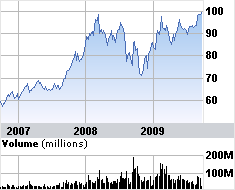
I felt it coming last week – a wave of positive stories about US banks doing better, with the icing on the cake arriving today with news of Citigroup’s record quarter. The markets have soared and gold has plunged.

I’m not the only one who sees this as a classic sucker’s rally. The Times’ smartest columnist looks at the breaking news and sees irrational exuberance aplenty.

Wells Fargo, for example, announced its best quarterly earnings ever. But a bank’s reported earnings aren’t a hard number, like sales; for example, they depend a lot on the amount the bank sets aside to cover expected future losses on its loans. And some analysts expressed considerable doubt about Wells Fargo’s assumptions, as well as other accounting issues.

Meanwhile, Goldman Sachs announced a huge jump in profits from fourth-quarter 2008 to first-quarter 2009. But as analysts quickly noticed, Goldman changed its definition of “quarter” (in response to a change in its legal status), so that — I kid you not — the month of December, which happened to be a bad one for the bank, disappeared from this comparison.

I don’t want to go overboard here. Maybe the banks really have swung from deep losses to hefty profits in record time. But skepticism comes naturally in this age of Madoff.

Read the Krugman piece to see why the most that can be said at the moment is that things have been deteriorating a little less dramatically than in previous months. The economy is worse, not better, and all those factory closings and bankruptcies and high unemployment rolls are still looming. This holds for China too, where the propaganda wave insisting that China is back and has emerged from the crisis unscathed, if not stronger than ever, is deafening. The shock waves of GM disintegrating, along with a number of malls and real estate companies, have yet to hit. And again, we see parallel situation in China.

It seems that thinking happy thoughts can actually convince people we’re okay. I wish we were so I wouldn’t have to worry about my family and my mortgage. But I have to think we’re still at the beginning, not the end. We’ve still got two wars to fight on top of all our other miseries, and in case no one’s noticing, another looming hotspot is now a tinderbox that will almost inevitably suck us in.

Thinking happy thoughts is made possible by obfuscation of information. Behind the propaganda wave is a treasure trove of information the powers that be do not want you or me to know. It would spoil all the fun.

U.S. taxpayers need to know the risks behind the Federal Reserve’s $2 trillion in lending to financial institutions because the public is now an “involuntary investor” in the nation’s banks, according to a court filing by Bloomberg LP.

The Fed refuses to name the borrowers, the amounts of loans or assets banks put up as collateral under 11 programs, arguing that doing so might set off a run by depositors and unsettle shareholders. Bloomberg, the New York-based company majority- owned by Mayor Michael Bloomberg, sued Nov. 7 under the Freedom of Information Act on behalf of its Bloomberg News unit. It made the new filing yesterday.

“The Board’s arguments are based on wispy speculation, lack evidentiary support and are contradicted by economic theory,” said Thomas Golden and Jared Cohen, lawyers with New York-based Willkie Farr & Gallagher LLP, in a motion asking the judge to require disclosure.

“These government actions, which have been shrouded in secrecy, are at the heart of Bloomberg’s FOIA requests,” the attorneys said.

Why the shroud of secrecy, the omerta among the boys behind the curtain? It’s pretty obvious to me: they know if we know what they know there will be a stampede out of the dollar like we’ve never seen before. If you choose only to look at the warm and fuzzy reports the banks are putting out to make things look happy you’re only fooling yourself.

I think this will go on for a couple more months, maybe even through the summer. But as the reports come in from the big companies revealing a devastating recession that is only getting worse, the floodgates will have to open and hell will have to break loose. China may escape some of that because they can control information better and keep propping things up with more cash. But it’s got to get uglier for both of us. Domestic consumption is not going to save China. The bottom line is, too many Chinese consumers are simply too poor.

So as we enter a phase of increased optimism and hope, I am gloomier than ever. In case you’re feeling a deluge of optimism, please start reading this guy on a regular basis. He’s saying what I’m saying, only better.
15
Comments

Anniversaries and Tea Parties

Today is not only “tea party” day and income tax day, it’s also an anniversary of a most important occasion, one that, although unnoticed in the West at the time, would soon lead to a series of jaw-dropping events that drove us to sit around our TV sets transfixed and incredulous for many weeks. It’s a good reminder that the bigger anniversary, the one for the non-event that can still scarcely be acknowledged looms but a few weeks away. Please rush to that site now, and follow the links. And fasten your seatbelts for what’s to follow in a few weeks.

Back in the motherland, I’ve been watching in amusement and amazement as the “tea party” nonsense titillates the right into paroxysms of ecstasy. All I’ll say is this: The tea parties are code. They have nothing to do with taxes. They are all about anti-Obama rage, racism, fundamentalism and the Limbaugh-Rove-Malkin axis-of-sleazels’ wet dream of imitating the Nuremberg rallies in America. The astroturfed, Fox-news-sponsored orgies of faux outrage are simply a continuation of the 2008 campaign’s insistence that Obama was a socialist Muslim terrorist born in Kenya and out to plunder the US treasury and turn the US of A into a Caliphate.

Not sure that Fox News was a sponsor? Go here; ignore Olberman but watch the Fox compliation. Priceless. And here’s my quote of the day on this topic:

[T]he teabaggers are full-throated about their goals: they want to give President Obama a strong tongue-lashing, and lick government spending — spending they did not oppose when they were under Presidents Bush and Reagan. They oppose Mr. Obama’s tax rates, which will be lower for most of them, and they oppose the tax increases Mr. Obama is imposing on the rich, whose taxes will skyrocket to a rate about ten percent less than it was under Reagan. That’s teabagging in a nutshell…

I have lots to say about lots of things but can’t muster the energy after work at the new job. I’ll aim for the weekend. Sorry to under-perform here this month, but transitioning to a whole new life is a challenge.

Update: Excellent update and great perspective on these pseudo events by a smart China blogger.

18
Comments

China stepping up or slacking?

Gady Epstein, Forbes’ man in Beijing (and a renowned Scrabble player), takes a look at the G20 talks and the seemingly universal notion that all the tough work lies on the shoulders of the US and China, a country that, as all fashionable pundits know, has failed to provide leadership and avoided sitting down to work out serious solutions. Which, Epstein says, is pure nonsense. Europe, he says, is the real slacker.

China in particular has stepped up to take an active leadership role after years of calls by Western nations to do so. Aside from its domestic efforts, China is pushing for IMF reforms that, while seeking to elevate China’s role in financing poorer nations, should also result in a more robust and better-funded IMF, which the developing world badly needs.

China has spoken up on the dominant position of the U.S. dollar in global reserves and trade payments and has made several deals with trading partner nations to provide export financing in its own currency. This is potentially helpful in an economy where trade financing has become scarce. And it would be misreading things to say that the Chinese are seeking to undermine the dollar, which, after all, they have bought so heavily to hold down the value of its own currency (and so make its exports cheaper).

No, China is, quite literally, invested in the global financial system as it is and, seeing that system in trouble is weighing in with real leadership. Many will disagree with some of the positions China takes from here forward, but now is the time to turn attention elsewhere. Now is the time for countries that have long wanted bold steps from China, the countries of Old Europe, to take some bold steps of their own.

The gist of the argument is the US and China’s stimulus plans, for all their faults, are big steps in the right direction. France and Germany’s plans are relatively toothless, and their commitment to serious stimulus simply too small.

I couldn’t help but notice how this assertion of China’s commitment and involvement contrasted with a recent column by Paul Krugman:

The bottom line is that China hasn’t yet faced up to the wrenching changes that will be needed to deal with this global crisis. The same could, of course, be said of the Japanese, the Europeans — and us.

And that failure to face up to new realities is the main reason that, despite some glimmers of good news — the G-20 summit accomplished more than I thought it would — this crisis probably still has years to run.

Krugman’s main beef with China is that their strategy of amassing dollars was unstrategic, counter-productive, self-defeating and dumb. What Epstein is claiming – and what Krugman either doesn’t see or doesn’t agree with – is that China is actually facing up to the present realities better than most, and certainly better than “Old Europe.” Looking at Krugman’s column, I think he’s caught up in what China did in the past with its dollar strategy and unimpressed with its stimulus plan – which parallels the way he sees the US. Krugman says it’s all much too little much too late. Epstein is saying both the US and China, despite the sins and stupidities that led us here, are at least taking serious steps to turn the calamity around and should be applauded for that.

I know there’s some “apples and oranges” in comparing the two columns. Krugman’s is more historical (and extremely critical of China’s role in the meltdown), Epstein’s is more about what needs to happen next. It was the diametrically opposed conclusion each drew about China’s stepping up to the plate that stood out for me.

54
Comments

Just a short note on unhappy China

Too wiped out to put up anything new, and know I’ve been delinquent the past couple of days. In the meantime, two worthwhile links:

Unhappy China – a translation of one of the best critiques of the much-discussed book. (Via Danwei.)

An Unsure China Steps Upon the World Stage – a good read after the Unhappy China link above.

Aside from that, let me just make one brief observation: This week I’ve been reading scores of articles on the financial crisis from a wide array of Chinese media, some written in English and others translated into English. One thing I suddenly realized today: Nearly every single one of them begins by stating matter-of-factly, in more or less these words, “The global recession, which was caused by America’s financial irresponsibility….” At a point later on in each article, with uncanny regularity, appears another matter-of-fact reference, this time to the certainty that China’s situation is now improving, the worst is over and it’s now just a matter of putting the finishing touches on a successful stimulus plan.

Now, I am the first to admit this disaster was to a very large extent caused by American fiscal irresponsibility. However, I also know that the exact same message planted in the opening sentences of one article after another after another after another is no coincidence and is part of a propaganda campaign that has two clear intentions:

1. To make it clear that it was America’s malfeasance that spoiled the party, and
2. To make it clear that China is bouncing back rapidly and was better prepared for catastrophe (through its savings) and better prepared for the arrival of new world order to come.

Keep your eyes opened for similar memes. They don’t just appear in a vacuum, and they are clearly choreographed. And for the record (yes, another mandatory disclaimer), I am not necessarily disagreeing with either of those two items – there’s some truth to both, though how much is impossible to say yet. I’m simply pointing out that we’re witnessing a campaign to engineer the way Chinese people look at this disaster – as entirely America’s fault, without question, and China’s opportunity. China was blameless, a victim, but thanks to its wisdom it will ultimately benefit from America’s blight on the world.

Both of the two links above offer insight into this mentality and how it relates to the present mood in the country. The popularity of Unhappy China makes perfect sense.

43
Comments

Home stretch in Xi’an

We ran into some light rain in Chengdu after nearly 10 days of perfect weather; Xi’an however, is cold and wet, sleet turning the sidewalks into slippery black puddles. I didn’t come to Xi’an to sightsee (I was here before in 2003 to do that). It’s been about research for a new project I’m working on, and in terms of actually reaching some of my work goals, it was the highlight of the trip. (In terms of fun, it loses by a long shot to Yunnan.) I actually think I’m getting somewhere. Along with the work, Xi’an has also been about the best dumplings and yangrouchuanr I’ve had in my life, anywhere.

Short thoughts about Chengdu and Chongqing: Chengdu is as relaxed and as civilized as they say. Chongqing is a teeming, frenetic, hysterical mass of development and anarchy and impossibly random construction. Needless to say, I loved Chongqing, and liked Chengdu. The latter was a little too civilized for me, with things closing relatively early and the city generally lacking the breathlessness of Chongqing, or even Kunming.

Back in the real world…. Suddenly work opportunities have jumped from few to several, not all of them set in stone, but at least things are looking positive for the future. At the same time, I hear from my twitter friends recently that out-of-work Westerners are arriving in droves to Beijing to take advantage of the relative work glut, real or imagined. A lot of the young Westerners arriving FOB don’t know anything about China’s visa policies, or anything else about China, but this is the Last Great Hope, according to my friends. It’ll be interesting to see how they fare, and what their presence means for freelancers here like me (like lower fees and greater competition for work as China becomes the biggest buyers’ market on the planet).

There’s no question now that MNCs are continuing to place even more hope and investment in China, accelerating their efforts to the clicheed fever pitch as they strive, maybe a bit desperately, to tap into “the final frontier.” The thinking seems to be this is the last possible bright spot on a planet consumed in a morass of economic chaos, confusion and despair. (Their thinking, not necessarily mine.) Time will as usual tell if they’re right, but as far as bets go, this one doesn’t seem too insane to me.

I wanted to meet friends for business in Guangzhou and Shanghai next, but time is running out and I really want to see Pingyao. On the other hand, it will be freezing in Pingyao, and Guangzhou will be a relative paradise of tropical breezes. And I really should see those business associates in Shanghai. So once again I’m using my blog as a sounding board to help me figure out what to do next.

Update: I’m probably going to go back to Beijing early. Enough travel; ever since Lisa went west and I went east two days ago I’ve sort of lost interest and feel it’s time to get back to Beijing. Work to do, promises to keep, etc.

47
Comments

Commodities plunge, gold soars

I took heat in other threads for maintaining that gold was more currency than commodity; you can always sell it and use it, in effect, as a currency. Thus, as true commodities like oil and copper deflate, gold goes up during times of economic uncertainty. No, you can’t buy a candy bar with it, but gold is always, always the safe haven during a crisis, and if this isn’t a crisis…. I think this theory holds water.

Meanwhile the dollar is doing great, for now. That’s not due to any great faith in the US economy, rather to the awfulness of other currencies (have you checked the Euro lately?). When the auto industry goes belly-up in April, the dollar will crash, hard.

Investors have taken to terming the flight from risky assets into gold a new currency trade. The ongoing concern about the enormous task of getting the world’s banks on track — bedeviling investors across the globe — has produced a safe-haven trade into the likes of Treasurys and the dollar. However, the dollar’s success is, in some ways, a mirage, improving only because other major world currencies have been dreadful.

The dollar has strengthened in the last couple of months, along with gold, which is an odd occurrence, and speaks to the dearth of worthy investments around the world. But the shift to gold has picked up as “everyone is trying to devalue their own currency against everyone else,” says Sean Peche, manager at BlueAlpha Investment Advisory Limited in London.

Gold is nearing its highs from last summer.

That explains the dollar’s strength of late, one founded on risk aversion. Since the beginning of the year, the dollar has gained 9.5% against the euro and 2.3% against the pound, while gold, in dollar terms, is up 9.4%. The yellow metal closed up $25.50 to $967 an ounce Tuesday, highest since July 17, 2008. “Gold is telling you the dollar’s rally is not going to continue,” says Lance Lewis, fund manager at Lewis Capital Partners.

Please fasten your seatbelts. Gold is going to $2,000. I know, I have no idea what I’m talking about, as my earlier posts indicate. It was 880 when I last posted about it two weeks ago; now it’s near 1,000.

Dali is like heaven. It wasn’t on our agenda, we sort of stumbled here, and don’t want to leave. Onto Chongqing tonight.

53
Comments

Tibet is, was and always will be….

A wonderful post by a China historian, inspired by a conversation with a Chinese friend:

Today YJ and I were discussing for the 1000th time the Τιbetan question and I suggested that my disdain and distaste for the Party line (and its supporters and parrots at home and abroad) had little to do with their opinion or right to hold such an opinion, but rather that the claims this group tended to make were of a different intellectual tradition than my own. The “Τιbet always has been, always will be part of China” crowd are starting from a point of certainty and proceeding to mine the past to create a narrative in support of that predetermined certainty. Complexity and nuance need not apply.

I’m not disputing the assertion “Τιbet is a part of China” or even “Τιbet was historically a part of China,” just that such assertions are built on unstable ground. The problem of Τιbet involves highly complex questions of sovereignty, authority, national identity, (de)colonization, and the evolution of empires into nation-states. Even the very definitions of these ideas, never mind how such ideas were understood in the past, are subject to discussion and debate. Thus the above assertion on Τιbet isn’t “wrong,” but the glassy-eyed certainty with which it is uttered and the narratives which support it deserve to be unpacked and the constituent parts looked at carefully and critically. For me, the counter to “Τιbet is part of China and history says so” is not “Τιbet is not part of China and history says so” but rather “How can you be so sure? Did you look at it this way?”

It then examines how historians’ minds work when it comes to reaching conclusions that then go on to become mainstream. shibboleths. This is not really a post on Tibet, but on drawing historical parallels in general. Its conclusion certainly got me thinking:

Indeed, the rhetoric of same sex marriage and gays serving the military disturbingly resembles the rhetoric against miscegenation and mixed-race army units in the 20th century. Similarly, the suggestions that PRC control of the Tibetan plateau was a strategic necessity, a humanitarian mission of liberation, or a benevolent paternalism which brought “modernity” in the form of hospitals, schools, and infrastructure to the benighted locals is fiendishly close to the justifications used by European and American imperialists in centuries past (and recent years).

Ouch. Please go read it all.

43
Comments