Racism in China vs. America

I blogrolled these guys two weeks ago and have meant to call them out. This post on racism in China (if, of course, it exists at all) and how it compares with that elsewhere gives me special reason to do so. Note especially the delicious update and the excellent comments.

This is a consistently excellent blog that impressed me from day one.

Update: Interesting link from the comments thread. I’d mentioned on this site before an anecdote about my first coming to China in 2002 to take a course at Fudan Daxue. There, a California-born Chinese-American student who could barely speak a word of Chinese was in despair that no Chinese students would accept him as an ESL teacher because he “didn’t look like an American.” They couldn’t deal with the idea of being taught English by a Chinese person, even if what made him “Chinese” was purely superficial. Hearing him that day asking our Chinese teacher how to convince students he was a native English speaker, and hearing the teacher tell him there was nothing he could do — well, that’ll stay with me forever. Mandatory disclaimer: Americans have a long and ongoing history of racism, and often, as the China Geeks story and comments indicate, it manifests itself in uglier ways than it does here. Now that we’ve got that out of the way…

55
Comments

A new job starting Monday

After several months of freelancing and studying and recovering from last August, I’ll be trying my hand at a new job in 12 hours or so. It’s still media-related, though more journalism than PR. We’ll see how it goes. I’m actually quite excited; finding this job underscored my sense that there are still plenty of opportunities for expats here in China, at least for those who look hard enough. (And in this case, I hardly even needed to look. I basically came upon it by happenstance.)

Of course, this will mean I can’t sit at home and blog. Or use Facebook or Twitter or other time-wasters. There’s still lunch hour and after work. I’ll do the best I can.

And thus begins yet another new phase in my life.

Update: Looks like blogspot blogs are blocked in China yet again. That would be an infuriating nuisance.

Update 2: For those working on their Chinese like me, please check out this post on the integration of Chinese Pod and the newest version of the Pleco dictionary. Pleco founder Mike Love explains how it works. I am a big fan of both, and I’ve discovered that Pleco flashcards really do work. I use them everyday when stuck in traffic and on the subway.

19
Comments

Traveling again

This time it’s for business. Blog activity to grind to a halt, bringing to a close the most intense two weeks or so of blogging that I’ve done in years. I think I got more inbound links to posts of the past two weeks than I did in all of 2008. All good things must come to an end, I suppose. Use the open thread below for miscellaneous comments.

No
Comments

Thread

Where there’s life, there’s thread.

75
Comments

How to be a fenqing

A smart, funny piece about one of China’s most interesting phenomena. Do not miss the inane Tibet video (may need to use a proxy) and Froog’s takedown thereof.

This was the second post in recent days I saw that refers to the unique mix of commenters here at TPD. This is a page from a most bizarre wiki that refers to “the trollfest that is The Peking Duck.” If anyone can decipher what it all means, I’d love to know. The reference to ferin and Invisible Sky Magician is particularly puzzling.

Update: Jeremiah chimes in, and he’s spot-on as usual. For example:

The fenqing are to most patriotic Chinese youth what the meth-riddled KKK rednecks on Jerry Springer are to the Republican party. They are wildly overrepresented on the internet, and the web gives this whacked-out fringe a powerful megaphone that amplifies their voices and adds to their self-importance.

Go there now.

Another Update (March 21): Latest comment by Froog over at the thread on his blog:

Dear Fenqing (all of you, any who may happen to be reading),

Please note that this post is humorous: it is making fun of fenqing, yes, but only in a fairly light way. And this is in the context of some other recent posts that equally make fun of fenwai (and of myself) and of some of the points that we often unfairly or over-provocatively make in our blog-commenting.

Please also note that the one serious point in this post, the basis of my and most other people’s criticism of fenqing (Chinese people’s criticism of them as well) is not what their views are but the aggression and self-righteousness with which they express those views.

Finally, please note that this post is not about any individual fenqing, or any individual argument they may have been involved in, or any individual view they hold. It is most certainly not about Tibet. Go check again – any mention of Tibet? NO.

If you want to portray yourself online as the kind of guy who just goes off on a rant about Tibet all the time, even when everybody else is talking about the economy or space travel or golf, well… go ahead. But you just make yourself look ridiculous. People don’t pay any attention to your opinions not because of the opinions themselves, but because you don’t know how (and when and where) to present them.

Now, go away, and please don’t come back.

Funny, no? Too bad it’ll go right over their heads as they keep going on about the T word.

59
Comments

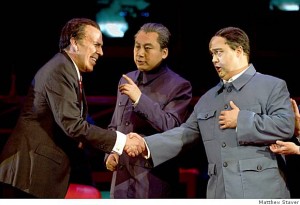
John Adams’ Nixon in China

dd-nixon16_ph_0498591077-1
Scene from John Adams’ 1987 opera

As friends of mine in Beijing know (to the annoyance of some of them, I’m sure), one of my latest obsessions has been John Adam’s incredibly beautiful opera, Nixon in China. It is not new to me; I was channel surfing back in the late 1980s when I came across a performance of the masterpiece on PBS. At the time, I wasn’t interested in any composer other than Wagner, but the soaring vocal line and dazzling orchestration made me put down the remote and listen. And watch.

I absolutely loved it. It was a strange thing; who would have thought Nixon’s trip to China in 1972 would be material for a full-blown opera? Who would think of either Richard or Pat Nixon as sympathetic characters? Yet it works, capturing musically and dramatically a remarkable cast of characters, not to mention the grandiosity of the occasion, the making of history.

I only re-discovered the opera a few months ago, when I decided to buy it on iTunes. The music is essentially minimalist, but with a healthy infusion of romanticism and lyricism. The score is tonal, the vocal line melodic and immediately memorable (unlike a lot of other minimalist music, which can be more about effect than melody). If China is one of your interests, there’s no excuse not to be familiar with Nixon in China.

One aria in particular, “I am the wife of Mao Tse Tung,” captured my attention, and it’s now the No. 1 most-played number on my iPod. It takes some getting used to the odd vocal leaps and repetitive melody. But if you can stick with it, I think you’ll agree that “chilling” is the best way to describe it. You can watch the entire scene here, and the performance is first rate.

And it’s not just the music. It’s a pretty perfect synthesis of music, singing, drama, and staging. Take a look at the singer playing Pat Nixon, at first puzzled, then fearful, for a moment positively terrified, then compassionate to the victim of Madam Mao’s wrath. Look at the clash of cultures as she (Pat) walks around the stage watching the unfolding drama with a look of complete disbelief. Look at the hysteria as Jiang Qing holds up Mao’s Little Red Book, her unctuous embrace of the Chinese performer, her haughtiness, her fanatical ideology and the echoing of her words by her automatons, a microcosm of the CR insanity, all unfolding under the serene gaze of a floor-to-ceiling portrait of the Great Helmsman himself.

Tragically, I don’t know the exact story of what’s going on in this scene and the libretto is under copyright so I can’t read the story scene-by-scene. (You can read the words to the aria here, but it doesn’t explain the context.) I want to know why Jiang Qing is so incensed, and what’s up with the guy with the gun. Still, these questions don’t diminish the effect of this clip. Watch it now. Overwhelming. Goose-bump-inducing. Sublime. As I said, it may take some getting used to, especially the cosmic high notes and leaps. But so worth the effort…

There are many other scenes you can find online. This clip of Nixon’s arrival in China is also one of my favorites. To see what I mean about the vocal line, listen to Zhou Enlai’s response when Nixon says he, Zhou, must be a constant traveler. Listen to how, after Nixon’s meaningless banter, the music captures the Chinese modesty reflected in the words, and how the vocal line suddenly soars as Zhou formally welcomes his guest:

No, not I. But as a traveller come home
For good to China, one for whom
All travel is a penance now,
I am most proud to welcome you.

That is vocal writing Mozart would have admired. And the intensity is sustained through every scene. Simply amazing. I used to think opera died at the turn of the century before last. I was wrong. Nixon in China deserves to be remembered as a seminal work, one of the great classical achievements of the 20th century. There’s nothing quite like experiencing the work of a genius.

25
Comments

Trip Report

If you aren’t following Lisa’s incredible coverage of her trip to Xinjiang, get over there now. If only I had the patience and thoroughness to write like that….

8
Comments

China, the next big enemy? (No.)

[Update Note: Danwei had the photos and some great commentary hours before the article cited below. Good work, and sorry I didn’t see it until now! Great comment thread over there, too.]

This story totally blew me away. I’m not saying I swallowed it hook, line and sinker, just that it made my jaw drop as I wondered how much of this is actually true? The writer is famous and hard to pin down politically (adores Ayn Rand, worked for Ralph Nader, etc.), and he’s obviously no dummy. (Strange, but not necessarily stupid.)

The article has to be seen, because the photos are essential. I do want to quote one section, however, that echoes my immediate reaction upon hearing of China’s “harassment” of the US Navy’s Impeccable.

Imagine if Chinese military vessels appeared 75 miles off the coast of, say, southern California, for the quite obvious purpose of tracking our submarine defenses and conducting surveillance of our San Diego naval base. It would be bombs away, pronto, and no questions asked. However, the Chinese penumbra of sovereignty is apparently more restricted.

Beijing claims U.S. actions violate the UN Law of the Sea, a treaty to which they are signatory and the U.S. is not. However, in contesting this assertion – which came up in the aftermath of the last Hainan incident – U.S. officials routinely note that the UN law, while granting China sovereignty over its “exclusive economic zone,” would have been violated only if the Impeccable was on a commercial expedition, and yet the clear concern on the part of the Chinese is that this was a military mission.

We have our Monroe Doctrine, which was specifically aimed at the crowned heads of Europe, who, in our nation’s youth, posed a threat on our very borders. (This same doctrine, ironically, was later tweaked and twisted into a rationale for our own imperial ambitions in South and Central America, as well as Mexico.) Other nations, however, are not entitled to a Monroe Doctrine of their own: China, Russia, and Iran have no corresponding prerogative to their own spheres of influence, as granted by geography, tradition, and the military necessities of a credible defense.

This made me think of an incident n the 90s when Cuba shot down two cuban exile-owned aircraft dropping anti-government leaflets on the streets of Havana. The planes had taken off from Florida. What would happen, I kept asking myself, if Cuba allowed aircraft to take off to fly over downtown Manhattan dropping anti-US-government leaflets on the sidewalk and all over Central Park?

For the past five years, the group’s volunteer pilots have patrolled the Florida Strait seeking refugees fleeing Cuba on makeshift rafts. In the past, the group’s aircraft reportedly have buzzed the Cuban capital, Havana, to drop leaflets attacking President Fidel Castro.

Castro replied with a warning that any aircraft violating the country’s airspace would be shot down. In Seattle, President Clinton “condemned this action in the strongest possible terms.”

The group, Brothers to the Rescue, had been praised in the US as heroes. And yet if the tables were turned the Monroe Doctrine would be put into play in seconds. We would never stand for it.

Okay, back to China. I realize this could be jumping the gun because I can’t fact-check Raimondo’s article. But looking at his track record I have to say I admire his original thinking and refusal to be slotted. His closing words on China make sense, at least until he gets to that one sentence about the Falun Gong:

There is plenty of anti-Chinese political sentiment in this country, and it’s a constituency that is bipartisan. Among the Democrats, you have organized labor, which is instinctively Sinophobic in this country and always has been, as the history of the oppression of Chinese coolies in California amply demonstrates. The protectionist unions are in a lather about the fact that Chinese workers produce cheaper and better products that American consumers want to buy. In tandem with international do-gooders of every sort, the anti-China popular front also consists of Republicans of the sort who will welcome any fresh enemy, as long as it means more subsidies for the military-industrial-congressional complex. Throw in the wacko cultists of Falun Gong, and what you have is the reincarnation of the old, bipartisan anti-Communist alliance of yesteryear, which brought us wars in Korea and Vietnam – and may yet succeed in provoking a third war on the Asian landmass, one just as futile and unwinnable as its predecessors.

The formulation of American foreign policy is all about domestic political pressures. It is the domain of lobbyists and de facto foreign agents, most of them unregistered, who work with targeted American constituencies to further various commercial and foreign interests. A rational foreign policy, i.e., one that serves authentic American interests, is virtually impossible in these circumstances.

Chas Freeman keeps coming to mind as evidence mounts all around us that we want – demand – to remain in a state of denial and delusion about Israel and China and just about everything else. Maybe it makes us feel safe. We want “analysts” who make us feel like were getting into a warm bath, all snug and safe. Ironically, it is precisely this self-delusional state of mind that landed us in the financial crisis that could well wipe out our dreams and our bankbooks.

Again, go see the photos and read the whole thing. And again, read the Wikipedia entry on the author. Too bad he sounds a bit crazy on why we entered WWII, and in his admiration of Charles Lindbergh. If you can put that aside….
71
Comments

China’s Way Forward

James Fallows does it again, with a detailed look at why predictions that China will follow either the Soviet or Japanese paths to economic disaster don’t hold water. There are too many sharp differences between China’s economic situation and theirs.

It’s nearly 1.30am and I don’t have the fortitude to do a detailed analysis of the article now, except to say it makes some points that should be obvious to us all but somehow seem to slip off our radar screens. Like, the USSR’s manufacturing capabilities were a pathetic joke by the time they went under, while China’s are at this moment among the most robust in the world.

And that’s all I have time for. I just want to get word of this piece out there so you can read it for yourselves. One snip from the very end, after the writer has enumerated some rather startling possibilities for creativity (and for profits) the crisis poses for China and dashed the shaky comparisons of China with Japan and the USSR.

CHINA IS DOWN. It is not out. This has important implications for America.

If China were truly like the old Soviet Union, the coming mass unemployment might be the shock that finally turned the people against their rulers. If it were truly like Japan, it might spend a decade or two chugging along but not aligning its systems to new international realities. In either case, Americans might feel sorry for China’s still-impoverished masses—but less worried about its competitive challenge.

I suspect that China will be like neither. Most of its people will still be very poor. Most of the jobs they hold—when they have jobs—will still be near the bottom of the global value chain. But they will not, I believe, be in fundamental revolt against the country’s governing system. And the companies they create, manage, and work for will be constantly trying to improve their position on that value chain. Two years ago, after reporting on factories in Shenzhen, I described an economic symbiosis in which Chinese workers assembled many of the world’s products—while inventors, designers, shareholders, and consumers from America or other rich countries got the lion’s share of the financial returns. It is the announced policy of the Chinese government, and of many Chinese companies, to keep more of the rewards in China.

Outsiders can rightly criticize the Chinese government if it tries to sneak in new export subsidies or push the RMB’s value back down. But no one can criticize its ambition to increase the rewards for its people’s work. Many Chinese companies will fail or make mistakes under today’s intense pressure. But many are using the moment to prepare for their next advance. The question for Americans to think about is how we are using the same moment.

Kind of reminds me of Chas Freeman, willing to challenge sacred cows and acknowledge that whether we like the Chinese government/system or not, there are some things it’s doing that are worthy of our attention. Who know, we may even learn something from them.

43
Comments

Chinese lessons – recession-proof?

Chinese Pod’s Ken Carroll hits the PR jackpot today in a full-length profile with a branded photo in one of the world’s great papers.

Ken Carroll is challenging a basic tenet in the global economy: that we all need to learn Mandarin Chinese to conquer the world’s largest market – but that learning Chinese is boring. Mr Carroll, a Shanghai-based language teacher turned internet entrepreneur, says that does not have to be so: he has pioneered a painless podcast method for learning Mandarin, and nearly a quarter of a million people worldwide are using it on Chinesepod.com, which sends daily Mandarin lessons to iPods and Google phones around the world.

Chinesepod revenues have defied the global economic downturn, too, rising 250 per cent from December 2007 to the same month last year and climbing strongly again in January, according to the company. Study without suffering may sound too good to be true, but there seem to be plenty of people willing to listen to this particular siren song, especially now that more professionals are taking enforced vacations from the workforce, giving them time to learn new skills such as languages.

Investment analysts think education in China could even prove to be a recession-proof business. Bejing’s National Office for Teaching Chinese as a Foreign Language says 40m foreigners studied Mandarin last year. Chinesepod is riding that wave: with China’s economy expected to grow by 8 per cent this year – compared with a flat global economy – learning Chinese has rapidly begun to look like a clever investment.

Let me just say I renewed my subscription to Chinese Pod about three weeks ago, and rely each week on a steady diet of both their podcasts and those of their competitor – each useful in its own way. Chinese Pod has become an institution, and for good reason. I can criticize them for this and that, but in the end all that matters is this simple truth: they helped me push from the elementary to intermediate level, and provided me with a panoply of practical phrases I use all the time.

Education in general seems to be a smart way to go during the great recession, with many people returning to school due to job scarcity. Teaching Chinese is positively brilliant, because the number of customers willing to spend money on it is growing constantly. These should be good years for language tools that can actually make a difference, and Chinese Pod really made a difference for me. Well done, Mr. Carroll.

8
Comments