Chas Freeman exits

I wrote a long post last night about why it would be wrong if Chas Freeman were forced to back out of his nomination for head of the NIC. It wasn’t finished and I didn’t post it and I now see the point is moot. One point I made in my draft was in regard to the third-rail of Israel, which will incinerate anyone who even hints at looking at issues from any perspective but Israel’s. (By my simply writing those words, I lean up against the third-rail myself.) And I am speaking as a Jew and as a supporter of Israel. Supporter – not a blanket endorser.

I know the LGF and Michelle Malkin crowd will be crowing for a while, and some will point to Freeman’s parting words as proof of his “anti-Semitism.” What he says about the smothering Israeli lobby is accurate. It is not in any sense anti-Semitic.

Still, I am saddened by what the controversy and the manner in which the public vitriol of those who devoted themselves to sustaining it have revealed about the state of our civil society. It is apparent that we Americans cannot any longer conduct a serious public discussion or exercise independent judgment about matters of great importance to our country as well as to our allies and friends.

The libels on me and their easily traceable email trails show conclusively that there is a powerful lobby determined to prevent any view other than its own from being aired, still less to factor in American understanding of trends and events in the Middle East. The tactics of the Israel Lobby plumb the depths of dishonor and indecency and include character assassination, selective misquotation, the willful distortion of the record, the fabrication of falsehoods, and an utter disregard for the truth. The aim of this Lobby is control of the policy process through the exercise of a veto over the appointment of people who dispute the wisdom of its views, the substitution of political correctness for analysis, and the exclusion of any and all options for decision by Americans and our government other than those that it favors.

There is a special irony in having been accused of improper regard for the opinions of foreign governments and societies by a group so clearly intent on enforcing adherence to the policies of a foreign government – in this case, the government of Israel.

I went back to some of the lines the sharks were tossing around, making Freeman look like he spends his days plotting the death of Israel, but only when he’s not actively encouraging PLA soldiers to shoot more students. I went back and looked at the context of one of his most sensationalized remarks and saw how easy it is to take words from a panel discussion wildly out of context and use them to destroy someone’s career. This was the Wurlitzer at its best, repeating ad nauseum the “gotcha” line with zero context and just lots of faux outrage and indignation. And it worked.

The intelligent arguments of intelligent people were ignored, unsurprisingly.

Again, I think in the course of his career Freeman said some ill-advised things. But nothing to merit the tidal wave of fury and slander that followed. His nomination gave me hope that “Change We Need” was a serious mantra – and no, I’m not referring to Freeman’s individual policy ideas on China or Tibet or Saudi Arabia. The “Change We Need” was that demonstrated by Obama in daring to nominate someone who thought outside the status quo and refused to be intimidated by political correctness and sacred cows. I admired Obama for having the courage to nominate such a person who, along with his willingness to reject myths, would have brought “truly independent intelligence analysis” to the table.

As former US ambassadors wrote in a letter to the Wall Street Journal recently:

A number of statements have appeared objecting to the appointment of Ambassador Charles “Chas” Freeman as head of the National Intelligence Council based on his political views (”Obama’s Intelligence Choice,” by Gabriel Schoenfeld, op-ed, Feb. 25). We, the undersigned former U.S. ambassadors, have known Chas Freeman for many years during his service to the nation in war and peace and in some of our most difficult posts. We recognize that Chas has controversial political views, not all of which we share. Many individuals with strong and well-known views have, and are being asked, to serve in positions of high responsibility.

The free exchange of political views is one of the strengths of our nation. We know Chas to be a man of integrity and high intelligence who would never let his personal views shade or distort intelligence assessments. We categorically reject the implication that the holding of personal opinions with which some disagree should be a reason to deny to the nation the service of this extremely qualified individual. We commend President Obama and Admiral Dennis C. Blair for appointing Ambassador Freeman to such an important position.

But this is politics, and there’s little room for dispassionate analysis and logic. So the calm, clear-headed voices of our best and brightest were drowned out by the hysterical and cynical roar of the self-righteous right.

We have suffered a complete and total defeat. If we only appoint people who suck up to the status quo and rubber-stamp anything put in front of them by lobbyists from a single country, the change we need won’t be coming anytime soon. We’ve allowed fear-inducing innuendo to triumph over reason. A sad day for America, a country that needs fresh perspectives now more than ever.

Update: See what one our smartest bloggers/thinkers said about Freeman some years ago. I know, some of us feel that any intimation that the CCP might actually succeed amounts to treason and commie-loving, as well as a tacit endorsement of the shooting of unarmed students. And that’s exactly the kind of sacred cow Freeman is willing to take on and challenge. Time to emerge from the Cold War with a new mindset, and to remove the shackles of black/white thinking and stereotypes.

Update 2: Let me give Sully the last word on this.

Obama may bring change in many areas, but there is no possibility of change on the Israel-Palestine question. Having the kind of debate in America that they have in Israel, let alone Europe, on the way ahead in the Middle East is simply forbidden. Even if a president wants to have differing sources of advice on many questions, the Congress will prevent any actual, genuinely open debate on Israel. More to the point: the Obama peeps never defended Freeman. They were too scared. The fact that Obama blinked means no one else in Washington will ever dare to go through the hazing that Freeman endured. And so the chilling effect is as real as it is deliberate.

When Obama told us that the resistance to change would not end at the election but continue every day after, he was right. But he never fought this one. He’s shrewder than I am.

How did we get here? How did we collectively become so stupid?
14
Comments

Threadless?

[Moving this to the top.]

I haven’t opened a thread in weeks, since traffic dies whenever I go away, and also because they’re magnets for trolls and my patience for trolls is at an all-time low. Now that I’m back, I’ll put one up just in case.

If you need some inspiration, here are some links to stories that caught my attention this week:

Women’s rights (or, the right to murder women)
Book Review: Capitalism with Chinese Characteristics (superb)
“Super China” (why, in this writer’s mind, China’s in better shape than the UK or US)

Please remember I’m monitoring comments, so it may take a while for your contributions to materialize.

65
Comments

Vive la France

I began to smell a rat as I read this post, and was glad to see the commenters did, too. Go take a look.

The great irony is that the pot was totally calling the kettle black – applying stereotypes to slime an entire people. If it’s inexcusable when the French do it to the Chinese, it’s just as bad when the Chinese return the favor.

This was where I lost any sympathy I may have first felt with the writer (who may have simply been making the whole thing up):

[H]e and his companions treated this airplane like a Parisian road-side cafe, chatting and drinking, pressing the stewardess call light, opening the window shades of the passenger cabin and allowing the sun to shine in. I controlled my temper, and used my expression and body language to communicate my displeasure, plugging my ears with earplugs in front of them. I need to rest! I politely said to my neighbor: “Can you please close the window shade?”

I truly did not imagine he would answer me like this: “Sorry, young lady, this window seat is mine, the plane ticket was paid with my money, you have no right to request this of me!”

I was stunned for a long time, not knowing what to say! This is the self-proclaimed friendliness, generosity, pursuit of romance and freedom of the French people? So what they were pursuing was their own freedom!

Please note how only a week earlier, as I traveled by train from XiAn to Beijing, I had to deal with a similar issue, but approached it with a somewhat different frame of mind:

My car-mates, however, were determined to ruin it. The two business partners smoked in the car (not allowed), kept the lights on and talked without a single break for 13 hours, making a mockery of the purpose of the overnight sleeper car, which is to sleep. I emerged in Beijing dazed and jet-lagged.
I strongly endorse the sleeper train from Xian to Beijing. I also would love tips on how to deal with selfish people who seem not to care about anyone else. Never had this problem before on a Chinese train.

My compartment mates kept smoking and talking for more than 12 hours, even after the conductor came in and told them to stop.

I was pissed, but it would be absurd to lash out at Chinese people in general because of two schmucks in my sleeper car. I’ve sat next to selfish people of all nationalities; China doesn’t hold a monopoly on them.

Read the China Smack post just to see how naively the story is accepted by some at face value, and how it pushes all the hot buttons – looting of the Summer Palace, French snobbery toward the Chinese, general French loathsomeness (from bad breath to racism), the Paris torch relay attack by a pro-Tibet activist, etc.

Another red flag popped up here:

Not only this, and perhaps as a result of of smoking, their mouths are very smelly.

Luckily, no one in China smokes, and halitosis is unheard of. Those are fresh roses you’re smelling in that taxi. The point being, throwing around racial/ethnic/national stereotypes usually says more about the accuser than the accused.

36
Comments

China 1979

Please read this book review by Pico Iyer, one of my favorite writers. It’s not for the weak.

15
Comments

Chas Freeman on Tiananmen Square, China’s human rights, etc.

I have to give this blog credit for their argument in favor of Obama’s pick to head the National Intelligence Council. Go look at their excerpted text of a leaked memo he wrote. I’ll just repeat a portion here, from a response he wrote in an exchange on China Security Listserv.

(2) The attack on “unarmed students” at Tian’anmen (actually at Muxudi and Fuxingmen and other locations outside Tian’anmen) came after many weeks, even months, in which the Chinese leadership had lost control of security in their own capital. (The troops were, in fact, fired upon at Muxudi, though it is not clear by whom.) The only surprise to me (and other realists, including, I gather, you) was that the Chinese leadership did not act earlier to restore order. We would have done so, judging by the precedents set by MacArthur and our National Guard over the decades from 1920 – 1950. The main lesson those leaders who survived the affair have drawn from it, in fact, is that one should strike hard and strike fast rather than tolerate escalating self-expression by exuberantly rebellious kids. If June 4 tells us anything about the Chinese leadership it is that they are reluctant, often to the point of rashness, to resort to the use of force against their fellow citizens.

(3) I am frankly stunned that you would argue that China has not “become more tolerant of dissent” in recent years. No one can have spent any time at all talking to ordinary people in China over the past two decades and have this view. Of course, outright opposition to rule by the Chinese Communist Party continues to draw a sharp response from the authorities. No government, including our own, is or should be asked to be prepared to tolerate efforts to overthrow it and the constitutional order it administers. (Ironically, despite our ideological predilections to believe the contrary, I am aware of no evidence that Chinese currently consider their government less “legitimate” or worthy of support than Americans do ours — but I defer to [name redacted by TWS] and other experts on this.) Certainly, China continues to fall far short of our minimal expectations for human and civil rights in many respects but it has made very significant progress on many levels. To deny this is primarily to raise questions about the extent to which one has been able to observe readily observable reality.

(4) You did not repeat the Rumsfeld / Rice canard that China has yet to make a decision whether to integrate itself into the existing order or to stand outside it. So you cannot be accused of embracing that quaint but hystrionic absurdity about a country that has joined just about every international organization and regulatory regime that exists, while emerging as a strong defender of the status quo in each against attacks on them, primarily from the US.

Like you, I worry that we will get China fundamentally wrong. It is certiain that we will do so if we allow our idées fixes and ideological preconceptions to guide our reasoning about China rather than deriving our conclusions from first-hand and empirically validatable data.

There’s a lot of stuff there. I can take issue with this or that, but I like the way he challenges the dominant paradigm and his willingness to question sacred cows. I also like that he strives to see the good along with the bad, in extreme contrast to the Bush people who would see Hamas and Hezbollah, for example, only as terrorist groups without understanding how they are perceived by the people who elected them and the role they play in those people’s lives. (Note that I am not saying they aren’t supporters of terrorism, only that it’s a bit more complex than that.)

I know the Tiananmen Square item will create a lot of hysteria. But it’s important you look at what Freeman actually said. I can hear the emotional outcry already: “Freeman is in favor of shooting unarmed students in the back!” But look at his words and put your emotions to the side for a moment. He was surprised the government “didn’t act earlier” – which is not to say he wondered why they didn’t start killing students earlier. The way the CCP handled it was clumsy and ultimately catastrophic, allowing the chaos to drag on for months and suddenly crushing it in a way that haunts them to this day. Of course they should have acted earlier and struck hard –to keep the country functional and to avoid a bloodbath.

To “strike hard and strike fast” does not mean to murder. I think its pretty clear Freeman means it in the sense of nipping the escalating crisis at its earliest stages, maybe with more meaningful negotiations and stronger insistence that bringing the capital city to its knees was not the most productive way to effect change. Personally, my pragmatic side wishes they’d used tear gas at an earlier stage to clear the square, while my idealistic side wishes they’d struck hard and fast by thanking the students for raising serious issues, and inviting them to work with them to change things. But the worst strategy was the dithering for months, which led to breakdowns that made the massacre all but inevitable.

Unfortunately the way Freeman worded it, with the words “strike hard and fast,” will no doubt leave him open to unfair criticism. Kennedy struck hard and fast during the Cuban Missile Crisis. If Freeman had said “respond quickly and emphatically” he’d be a lot better off. We Americans can get quite bent out of shape from out-of-context and misinterpreted remarks, which can damn a politician forever. We have to remember this was a note on China Listserv, not a formal policy statement.

To repeat what I’ve said so many times here: I admire what the students, for all their faults and, in some instances self-interest, achieved in 1989. June 4 is a dark cloud over China that will not go away. The government’s approach was horrific, no matter who fired the first shots (and I know all sides of the story and have seen the photos of the soldiers’ bodies on fire). I still get emotional when I think about this image, and I still remember the hope and the thrill I felt watching what seemed like a miracle unfold in the early days of the demonstrations. But it’s not nearly so simple as good versus evil. It never is.

There is too much dynamite-laced content in the memo to go through it line by line; each item could ignite an endless thread of disagreement. And as I said, I don’t agree with all of it. But I like the way Freeman seeks to clear away the clutter of fixed notions, stereotypes and myths, and I admire his willingness to put his neck on the line to challenge conventional thinking and then to back it up with an intelligent argument.

But don’t just take my word for it. Please go and read what the smartest journalist in China has to say about Freeman.

…I don’t know Freeman personally. I don’t know whether the Saudi funding for his organization has been entirely seemly (like that for most Presidential libraries), which is now the subject of inspector-general investigation. If there’s a problem there, there’s a problem.

But I do know something about the role of contrarians in organizational life. I have hired such people, have worked alongside them, have often been annoyed at them, but ultimately have viewed them as indispensable. Sometimes the annoying people, who will occasionally say “irresponsible” things, are the only ones who will point out problems that everyone else is trying to ignore. A president needs as many such inconvenient boat-rockers as he can find — as long as they’re not in the main operational jobs. Seriously: anyone who has worked in an organization knows how hard it is, but how vital, to find intelligent people who genuinely are willing to say inconvenient things even when everyone around them is getting impatient or annoyed. The truth is, you don’t like them when they do that. You may not like them much at all. But without them, you’re cooked.

So to the extent this argument is shaping up as a banishment of Freeman for rash or unorthodox views, I instinctively take Freeman’s side — even when I disagree with him on specifics. This job calls for originality, and originality brings risks. Chas Freeman is not going to have his finger on any button. He is going to help raise all the questions that the person with his finger on the button should be aware of.

The Bush administration suffered from a dearth of boat-rockers. Those who disagreed were shunted and silenced, labeled as “disloyal.” I’m impressed that Obama chose Freeman for this position, irrespective of whether I disagree with him on all topics related to China. Or the Middle East. He seems to have the kind of mind we need more of, and I hope he survives the inevitable firestorm these seemingly provocative – but actually rather down-to-earth – remarks will generate.

Update: Please be sure to see the new post I wrote about Freeman following his exit from the nomination. So much hoopla over remarks that, when looked at carefully, were well intended, non-provocative and intelligent. Such a loss for America.

49
Comments

“Will blond hair and plastic breasts play in China?”

That’s the sub-head of this article on the new Barbie store that opened in Shanghai yesterday. It’s well worth a read:

Barbie’s made-in-China makeover is part of a push to re-brand the iconic American doll on the eve of her 50th birthday. With domestic sales slumping, Mattel has set its sights on China, hoping to the weather the financial storm in the relative calm of the country’s vast — and comparatively untapped — consumer market.

The plan is to turn America’s favorite doll into fashion fodder for China’s upwardly mobile, trend-setting elite. By moving up-market and focusing on Barbie-branded merchandise, the company hopes to widen profit margins and attract a new demographic: Chinese women.

But, will they buy it?

Summer Wang, an assistant at a film production company, certainly will. “Barbie is beautiful like a princess,” she said. “And every Shanghai girl wants to be a princess.”

With malls closing, construction grinding to a halt and a general sense of malaise creeping in, will Chinese consumers continue to keep American companies afloat? I guess that’s the trillion-dollar question. I’m sure every Shanghai girl really does want to be a princess. Will mom and dad continue to finance this dream?

2
Comments

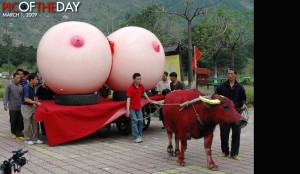
To get round is glorious.

chinese-art1

Caption: A sculpture of breasts by Chinese artist Shu Yong designed to increase people’s appreciation for natural curves in a country where plastic surgery is booming. Shu’s work is now being showcased to a rural audience.

This is purely a mental health break after posting lots of serious posts.

10
Comments

Blood in the streets: Desperate in Dongguan

I was in Dongguan on business several times in late-2007, back when life was fun and good. I wrote about an unforgettable event I saw there, and about the level of energy and excitement I saw. So much opportunity and hope. Limitless possibilities.

Not anymore. If this post is to be believed, and I have no reason to think otherwise (except perhaps that I want to not believe it), Dongguang has become a bit less inviting.

As I was out at a factory in Dongguang today I saw lines of people looking for work outside most of the factories we drove past. This is just one that we happened to stop in front of in traffic long enough for me to snap a quick photo. I counted 25 people or more outside multiple factory gates. I haven’t seen this since 2005.

Second, a security note. Two other people (who shall remain nameless), while in a different part of Dongguang today, saw a group of people on the side of the road hack another person to death (at least they think he died) with a machete. They kept on driving, sped up even, to get out of there as quickly as possible.

If you have money or are alone I would highly recommend that you DO NOT go out at night in any of the industrial areas outside of Shenzhen. This would include Songgang, Dongguang, Longgang, Bao’an, Guanlan, Shiyan, Huizhou and other areas with tons of (unemployed) migrant workers and not a lot of policing or economic development.

I’ve seen fights, I’ve seen people get robbed and beaten, I’ve seen a woman and child get run over by large dump trucks, I’ve even seen a dead body on the street (at least I think it was dead), I’ve had family tell me about kidnappings they’ve seen, I’ve had family robbed at knife point and I’ve been pick-pocketed numerous times myself. I’ve had clients tell me about huge gang fights they’ve see while making side excursions in shopping malls! I even chased down and dragged to the police station two guys who tried to steal my bike once. But I’ve never seen anything like this before.

Desperate people do desperate things. And right now in the manufacturing cities, times are as desperate as they can get. Except it will probably gets worse before it gets better. As many have said, there is no way this crisis will end without blood on the streets. The big question is whether this violence will spread from random acts of murder and robbery committed by hungry, desperate workers to an actual assault on China’s government. I think the government will be stable and will survive, for better or for worse. For some interesting perspectives on this question, see this post and its comments.

It’s going to be along, painful, frightening year. The Chinese people know that, and seem to believe their government is handling it as best they can. There’ll be more and nastier demonstrations, there’ll be more deaths and more despair. There’s won’t be a revolution, at least not from this crisis. People have planned and saved for it, and they are far more frightened of the chaos a revolution would bring than of the continued rule of a dictatorship most of the country credits with vast improvements in their lives. And again, that is not necessarily my personal viewpoint, but it is certainly the viewpoint of the man on in the street, whether in the Central Business District of Beijing or the train station in Kunming.

Silk Road link via Fool’s Mountain

14
Comments

Beijing’s “Let’s Burger” restaurant

First let me admit that I like the taste of this restaurant’s cheeseburgers, one of the foods I often find myself craving after days or weeks of only local fare. “Let’s Burger” opened just a few months ago in Sanlitun and I think I walked in by happenstance on one of their very first days in business. It’s run by a fellow from Hong Kong I chatted with that day, telling him his place filled a need in Beijing for a decent, non-fast-food hamburger.

There is such a need, but I decided Let’s Burger doesn’t fill it, and I don’t plan to go back again.

One of the first things that bugged me about the place is that there’s no free water, a courtesy nearly every restaurant here offers, from the cheapest to the most expensive. And you have a choice only of Perrier or Evian at prices horrific to contemplate. And this is the real rub: a can of soda is 18 kuai, which is highway robbery. This is a hamburger house, not a 5-star hotel. A glass of bad-tasting “house wine” is 38 kuai. A mango smoothie is nearly 40 kuai. (In America, that would be expensive.)

And then there’s the price of the burger itself. At first, 58 kuai for a cheeseburger seems kind of sane, since you always pay more for Western food here. However, it is not a meal in itself. It’s too small. Fries slap on an extra 25 kuai, so a burger, soda and fries will come to an unacceptable 101 kuai, or almost $15 USD. I might be willing to pay that around the corner at Blue Frog or Union Grill because you get your own private table and real service and they take your order from a menu – i.e., they’re real restaurants. Let’s Burger, OTOH, is cafeteria style. You stand in line, order off a big green board behind the cashier, they hand you a number and someone comes and drops the food at your table. You pick up the drink yourself. There’s no ketchup or anything else on the table; you have to get up and get it yourself.

This is not a good time for businesses to not give customers their money’s worth. I decided after leaving Let’s Burger hungry this afternoon that I’d never go again. They’ve got a great location, a decent enough product and a great opportunity to fill a need. A shame to see them blow it by being greedy and short-sighted. 101 RMB with no table service….

Pardon the rant. I was just soooo pissed this afternoon.

24
Comments

China’s Luxury Mall Calamity

More than two and a half years ago I wrote about the inevitable collapse of China’s luxury malls. A brief reminder:

Anyone who’s walked around Shanghai’s more prosperous areas (and Beijing’s as well) is well familiar with the glut of luxury stores, with Bulgari and Gucci boutiques everywhere you look. This always fascinated me – the sheer number of such places in areas where I knew there couldn’t possibly be enough customers to ensure sustainable long-term profitability. I would sometimes stand outside the shops and watch for as long as half an hour (I didn’t have much better to do on the weekends). I remember seeing the shopkeepers going to fantastic lengths to look busy. One of them kept dusting the shelves obsessively. Another kept a book (or maybe a magazine) discreetly under the counter, at an angle where she could read while keeping an eye on the front door. One kept rearranging her hair. Another must have had the best-filed fingernails in all of Asia. This wasn’t a scientific study, of course, but based on what I saw with my own eyes I was convinced the high-end luxury goods stores had been overbuilt, and that eventually they’d either have to pack up and leave or keep eating what had to be painful losses.

Today I visited Beijing’s most stunningly dysfunctional, catastrophic mall, called The Place, and all I could think about was what I wrote back in 2006. Made to look kind of like Versailles on the outside, The Place is an irrational maze of stores and eateries that seems to have been designed to turn off and turn away customers. It has stairways that lead nowhere, unmarked elevators that take you to surprising places, not to mention a generally chintzy feeling created by all the faux marble and Grecian columns; it always looked pompous, but now it’s looking seedy and run-down as well.

The Place is around the corner from my office, and this was my first trip back in about two months, I was shocked at what I saw. Fifty percent of the eateries in the basement were boarded up. The cheap food court, too, was gone, covered up with ugly blue boarding, making the basement especially grim and dreary. The two good restaurants there, Ganges and Master Kong Chef’s, were still thriving. The few others that remained seemed to be just hanging on.

That same night I went by The Village, which seemed so cool when it first arrived and now seems so unnecessary aside from the Apple store and a couple of restaurants. Same thing as The Place: lonely clerks looking plaintively out the store windows, eyes begging you to come in and buy something. But no one does. There is simply too much stuff, too many stores, and no buyers. Do you have to be a rocket scientist to conclude this is unsustainable? And to top it off, they are now finishing the second Village mall down the street, across from the Poppa Bear of all disaster malls, 3.3. All I can say is, WTF??

I’m predicting The Place and many of its sister ghost malls, shunned by customers overwhelmed by so many malls to choose from, each selling the same crap that no one can afford nowadays, are going to experience a catastrophe, if they haven’t already, and will ultimately become burnt-out, boarded-up shells. In turn, this is going to throw a lot of fuel on China’s current financial crisis. Real estate will be further cheapened, and the general misery unique to times of deflation will set in. Brother, can you spare a dime?

All I want to know is how we got here. I told them this was coming 2.5 years ago and no one listened. The day of reckoning, the moment of truth is here. Even if things pick up, these malls are hopeless. Like the Mandarin Oriental, they will need to be razed and replaced with something useful, like affordable middle class housing (wishful thinking on my part). If not, Beijing could become a city pockmarked with looming dinosaurs, huge husks of once breathtaking buildings, now vacant and decaying, like so many of the Olympic structures.

I kind of understand why this overbuilding happened, as the economy became a vicious inflationary circle. Now we are experiencing the down wave, and it’s just starting. As we crash, The Place and many other useless mega-malls like it will serve only as reminders of the excesses of good times that we fooled ourselves into believing would last forever. Their time has now come. In fact, their demise is long overdue.

45
Comments