Biggest news story ever – Tim Russert dies

A friend in America tells me the US media is now rending its garments and falling over themselves to show who can eulogize Tim Russert with the most pathos. It’s been all Russert all the time for days, from what I hear. John Cole sums up why this is so absurd, and why it’s a metaphor for just how fucked-up the US media is.

MSNBC has been running nothing but a 5 hour (and presumably it will go until 11 pm or beyond) marathon of Russert remembrance. CNN has done their due diligence, and Fox news has spent at least the last half hour talking non-stop about him.

But let’s get something straight- what I am watching right now on the cable news shows is indicative of the problem- no clearer demonstration of the fact that they consider themselves to be players and the insiders and, well, part of the village, is needed. This is precisely the problem. They have walked the corridors of power so long that they honestly think they are the story. It is creepy and sick and the reason politicians get away with all the crap they get away with these days.

Tim Russert was a newsman. He was not the Pope. This is not the JFK assassination, or Reagan’s death, or the Space Shuttle Challenger explosion. A newsman died. We know you miss him, but please shut up and get back to work.

Not only that – Russert wasn’t even that good a newsman. It’s a pity he’s dead, but people die. Let’s save the grief-a-thons for the real thing. When you take a look at all the issues we’re facing, from Iraq to earthquakes to recessions, the death of a news reporter from natural causes is a very, very small story. Or at least it should be.


30
Comments

“Apologies Forthcoming” – A Conversation with Xujun Eberlein

Xujun Eberlein grew up in Chongqing, China, and moved to the United States in the summer of 1988. After receiving a Ph.D. from MIT in the spring of 1995, and winning an award for her dissertation, she joined a small but ambitious high tech company. On Thanksgiving 2003, she gave up tech for writing. Her debut story collection Apologies Forthcoming won the 2007 Tartt Fiction Award and was published in May 2008. You can buy the book here. 

The stories in Apologies Forthcoming deal with the Cultural Revolution, which defined the generation now coming to power in China. Xujun departs from the more typical “victim literature” about the CR, and the stories show a broad range of perspectives, actions and responses to the turmoil of the period.

 Lisa: Tell us about the title of your collection, “Apologies Forthcoming.” Why did  you choose it? 

 Xujun: I had considered calling the book Men Don’t Apologize, but some writer friends objected. They pointed out that people would probably expect a feminist treatise, while I’m not a feminist at all. And the stories don’t actually have any agenda other than realistically portraying human behavior and psychology at a particular time. While that namesake story is about several men and a woman, the idea of apologizing for, or even acknowledging participation in, activities during the Cultural Revolution cuts across the sexes. Apologies Forthcoming was actually the publisher’s suggestion and I like it, though I am not sure we will ever see the apologies.  ☺

 Speaking about apologies, two years ago I interviewed a few ex-Red Guard leaders in Chongqing, who had been in jail for more than a decade and now are businessmen. I wrote a short journalism piece about this, which you can read here.

Let me just quote one of the men here – he said, “We castigated the capitalist roaders for two years. They punished us for many more.” He didn’t think he ought to apologize to anyone at all, and you have to acknowledge his point.

Lisa: Related to this question of apologies…my first time in China was in 1979, so the Cultural Revolution was still very present in peoples’ lives. At the time I felt like the country suffered from a massive emotional depression from the after-effects of so much mass trauma. And a number of Chinese people I met told me about some of their experiences during the CR – some very traumatic and personal things. I’m guessing this was because I was a young foreigner, not involved and therefore safe to confide in. Did you talk about your experiences with fellow Chinese? To what extent did people feel they could honestly speak about what had happened to them and what they had done during this time? Did you talk to anyone about your own experiences?

Xujun: Oh, plenty of people talk about their sufferings, but few mention their roles as participants. One representative example is the memoir Wild Swans. I admire the book’s writing, but as I mentioned in my Amazon review for it, I wish the author were more honest. Readers relish suffering stories, but suffering stories alone provide limited insights into human behavior.

It also occurs to me that few westerners know the subtleties and nuance surrounding the participating parties in the CR. I once did an informal poll among writers I workshop with on what they thought of the Red Guards, and the answers were pretty much uniform with the representative one being “pretty much the same as the Hitler Youth.” This is quite baffling and at the same time very interesting. As we know (I’m aware of the pitfall of generalization) Americans hate the communist government of China; but did they know the biggest thing the Red Guards did was to break China’s state apparatus? Should a communist hater applaud or condemn that? There is just no simple black-and-white answer.

Another thing is that the Red Guards consisted of an entire generation of students from middle school through university, and though viewed as a collective by westerners, there were many different factions emerging, converging, breaking down and reorganizing over times.

The Red Guards did have a hand in lots of violence, yet the individual members were often idealists. This complexity seems beyond the average outsiders’ comprehension. It is very hard for someone to understand another culture without actually experiencing it. But the real problem is not the limitation in understanding – everyone has limitations; it is failing to recognize limitations. Too many people are vocally righteous about other cultures they know little about, that is the problem.

As a writer, however, I am more interested in human behavior and the mentality that leads to it. I’m not interested in pointing fingers because what does that do to increase understanding? I think as realistic fiction the story “Men Don’t Apologize” departs from the usual victim literature and takes one step further in exploring human nature and the different behavior that manifests between ordinary and extraordinary circumstances.

I don’t want to digress too far on this topic, let’s just say that, as far as political conflicts are concerned, victims and victimizers can easily switch positions. The distinction between victims and villains is very unclear and my stories show a broader range of behavior beyond suffering.
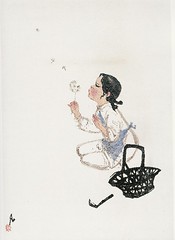
Lisa: “Snow Line,” the opening story in the collection, is set in Chengdu, a city I’ve spent some time in and really love. Even in the immediate aftermath of the Cultural Revolution, it felt a lot more relaxed and open to me than most of the cities I visited. It’s surrounded by a lot of natural beauty, and places like Qingchengshan, which is considered one of the birthplaces of Daoism.

I notice that flowers are a recurring motif in “Snow Line,” and I’m curious if this is something that connects specifically to Chengdu.

Xujun: Yes, Chengdu! My favorite city of all! (I hope my Chongqing townsmen will forgive me for saying this.) In the north it is Beijing and in the south it has to be Chengdu. Do you know a saying, “少不入川,老不出川” – “When young don’t enter Sichuan; when old never go out of it”? In this saying “Sichuan” actually means its capital Chengdu. Chengdu is such a relaxed and cultured city, a young man would only be spoiled there and never work hard, is what the saying means. But it is heaven for a relaxed and richly cultured life. Every year I go back for a visit, I can’t help but wonder how such a free and at leisure population make their livings. Yet they live leisurely on. All my close friends from Chongqing have moved to Chengdu by now.

And yes, Chengdu is a true flower city. Everywhere on the streets and in every season you see flower girls and flower stores. Even Chengdu’s air is fragrant and colorful. You don’t see or smell this in Chongqing for example. Don’t get me wrong, I love Chongqing, too, but that’s for its ragged hilly paths and two legend-filled rivers.

You can probably sense my love of Chengdu from descriptions in “Snow Line.” But the reason I placed “Snow Line” as the opening story is because of the artwork, “Dandelion.” The artist, Mr. Wu Fan, is a renowned “literati artist” in Sichuan, a very classic kind. “Dandelion” was his signature work and won a gold medal in the 1959 international block prints competition. During the CR the gold medal became a criminal indictment for him and nearly killed him.

Mr. Wu is a friend of my parents, and his daughter and I are friends. The genesis of “Snow Line” actually came from the daughter; she had modeled the little girl in “Dandelion.” I thought the artwork would add a nice dimension to my story, so I asked for permission to include it from Mr. Wu Fan, and he generously agreed. I ended up using three works from him, each fits nicely with one of the stories. His daughter did the sketch for “Men Don’t Apologize.”

When I was in college, every summer I would go to Chengdu and spend time with the Wu family. The mother, an oil painter, would bring her two daughters to paint from nature in Huanhua Xi – Wash-flower Brook, and I would go with them. Those were some happiest times of my youth.

Lisa: The first time I was in China, one of the phrases I learned right away was “work unit.” The idea that so many decisions about one’s personal life could be made by one’s place of employment was very foreign to me. “Snow Line” presents a typical situation in the China of the late 1970s to early 1980s, where a woman lives in the factory in which she works. The whole notion of privacy and personal space is very different from the West. So a two-part question – when you moved to the US, was this a difficult adjustment to you? And do you think that China as a society has moved towards more “Western” notions of privacy?

Xujun: Hehe, the phrase is still there, on everyone’s lips. And you ask an interesting question. When I am writing stories I wear the hat of the times, and this all seems perfectly natural. However, when I think about actually doing something like living in a printing factory it does seem pretty strange. It is curious how quickly I became accustomed to the easy (and private) life in the US. I don’t think I could make the adjustment in the other direction nearly so quickly. There is a Chinese word for that – xiguan – that would be used only in one direction.

China has changed a lot since the early 1980s, when I was in college. There is surely more privacy in people’s lives now. For example the question “How much do you make?” was as common as “Have you eaten?” in conversation when I lived in China. Now you hardly ever hear the former spoken. ☺
However I don’t think Chinese will completely adopt the Western notion of privacy – that would be very sad anyway. Neighbors still love to “chuan-men” (drop-by) without having to first set appointments, for example.

Lisa: “Feathers” tells the story of a girl losing her older sister. In a way it is a typically “Chinese” story, a Cultural Revolution tragedy. But on the other hand, the family dynamics transcend the cultural particulars and deal with universal themes of loss, denial and suffering.

Xujun: I think that is an important observation, and I think it may apply more broadly than just this story. People have a lot in common with one another, and a lot that sets us apart. “Feathers” is about family and dealing with tragedy, and this is an area where similarities are much stronger than differences. Still, the story tells a Chinese way of dealing with things, for example making up stories so the grandmother wouldn’t know about her grandchild’s death. I remember workshopping the story and some American friends just couldn’t understand why the lying was necessary. Some things that might stand out to a Western reader would simply be background to a Chinese reader.

You know, this story is close to my heart. And go back to your question earlier if I talked to anyone about my own experiences during the CR, I was a child when the worst thing happened to my family – my big sister’s death. She was a 16-year-old Red Guard. I had to safeguard my 75-year-old grandmother from knowing the bad news, just like in the third-person story “Feathers.” Imaging a 12-year-old girl running around bare her teeth like a fierce cat hissing at any gossipy neighbor who dared to mention the incident. That practice trained my habit of silence; for more than three decades I did not talk to anyone other than my diary book about the incident. I never shed tears either. I cried for the first time in 2002 when I began to write the memoir piece “Swimming with Mao”.

One question a reader raised was if my loyalty to my sister might have impeded my condemnation of the Red Guards. However, though my sister was both a participant and a victim of the CR, she foremost was my dear sister and no political identification could change that. This became never so clear after I started to write about her.

The story also reflects my aversion to heroism. When my sister died, her comrades called her a “hero.” As a child I was very confused by the notion that a life was tradable with the title “hero.” I just wanted my dear sister back – who cared what her title was?

Lisa: I particularly liked “Watch the Thrill,” with its two bored neighborhood boys who are looking for excitement. It’s not that they are bad or evil, they just seem to lack the capacity to make moral choices, and there are no adults around to guide them. This had a lot of resonances to me, both to kids growing up here and now without adequate parenting and to figures in classical literature – “Lord of the Flies” comes to mind.

Xujun: It is interesting you should mention this. There is a broader belief that youth and innocence should go hand in hand. In this story I wanted to portray not that the boys were bad, but that they really weren’t concerned about the concepts of good or bad, but just interesting or boring. Becoming invested in good and bad requires some reasonable landmarks of this type of judgment, and those landmarks were missing when these boys were raised. This makes the emergence of any sort of morality difficult.

86
Comments

June 4

That time of year again. I remember my rage back in 1989. It was the first time I ever watched CNN, and I was glued to the TV set although I knew next to nothing about China at the time. I remember my shock at Bush I’s “punishment” of the dictators with blood on their hands – some all but meaningless sanctions. The man who stood up against the tank, the stranger who entered all of our living rooms and shook the conscience of the world. The moment of hope, when it seemed to so many of us that the students were really going to make a difference and force their corrupt leaders to reform. No one imagined the idealistic young men and women would be greeted with live ammunition, shot dead in the streets like animals.

Nearly 20 years later it seems so far away, so distant. But not at all forgotten. At least not for me. Talking with my Chinese friends in Beijing, it also seems so irrelevant, something they would rather not acknowledge let alone dwell upon. I only really began to understand the Chinese perspective on the tragedy five years ago when I held an extensive conversation with an actual demonstrator. His words sounded so strange to me. He had gone to demonstrate, to actively protest against his government, and now he looks upon the massacre as a practical and necessary business decision. Painful to make at the time but ultimately good for the country. And I believe it’s safe to say that his opinion is in line with that of most young Chinese people today. There is almost a sense of gratitude for what the government did, saving them from the anarchy that consumed Russia in its rush to democratize. Preserving the harmony that allowed the economic miracle to rise to undreamed of height. Surely it was all for the best, and your heart has to go out to the poor officials forced to make such a difficult decision.

I understand his argument, and I understand why my Chinese colleagues across the board tow the line on this topic. Many months ago I gave up hope of having a rational discussion with them on topics like this. The last time I tried was about two weeks ago, when I argued with a beloved colleague about whether Mao had been good for China or bad. When I recited the litany of his sins, which are nearly as bountiful as Hitler’s, I got the tape recorded message that still, he was good for China. You know, seventy percent and all that. At least now I understand why she says that.

If you read my other posts on Tiananmen Square, you’ll know I don’t see the students as angels. Nothing is ever that simple. Nor were the party’s players all devils. Forces inside the party were grating against each other and…well, no sense in restating what most of us know. For me, the bottom line was that the party showed us just how ruthless and obsessed with self-preservation they were, not that there was ever much doubt. And for that, I can never forgive them, even if their own people can. I see what they are doing today, stopping parents who lost children to the Sichuan earthquake from demonstrating, and I remind myself that for all the steps forward, theirs is still an authoritarian government that can easily morph into a totalitarian police state when it feels threatened. The script is so similar; all of our hopes were raised when we saw the relative media transparency the state was allowing in the earthquake’s coverage. It didn’t take long to bring us all back down to earth.

And so we can wring our hands and complain and blog and point out the hypocrisy and the two-facedness and the outright badness. But as long as the Chinese people refuse to call the government to account or even to acknowledge its selfish intentions, like my friend who insists Mao was a net plus for China, meaningful political reform will remain minimal and painfully slow. Some uplifting spurts forward, some painful setbacks. It’s gotten better, as the cliche goes, but let’s not fool ourselves: if a similar threat were to arise now or in the future, those in power would be willing to replay the ‘incident” all over again. Reluctantly, for sure, but in the end it would be “the best thing for China.”

I’m in America for my last vacation before the fall. I know I’ve disappointed a lot of readers with the sparse posting, and no one is more depressed than I am at the inanity of some of the recent comment threads. I simply feel I have no choice. A lot of emails have gone unanswered and a lot of topics I’ve been dying to post about have gone unwritten. That’s the best I can do for now, and it won’t get better until the autumn. Let me just close by saying my work has involved me in the relief efforts for the children displaced and orphaned by the earthquake, and no matter how the government may have infuriate me in recent days, and no matter how frustrated I feel with Chinese friends who refuse to see the world as i do, the rush to help and sacrifice and give has been one of the most inspiring and moving things I’ve ever seen. As usual with China, a flood of contrary emotions collide, from tearful joy at the selflessness and generosity of the people to anger and impatience at the cruelty of some in the government to indignation over the corruption that allowed the schools to crumble. Each of these emotions is equally legitimate, and one does not invalidate the other.

Update: And let’s not forget, the TSM remains the most taboo subject in China. And for good reason.

116
Comments

Please keep your comments on topic

I started deleting off-topic comments in the last thread and realized that there would have been virtually no comments left if I’d continued.

Well, maybe two. 

Consider this an open thread if you must. 

158
Comments

Facing the facts

The fact is, I may not be able to post regularly until September. I am that busy, with meetings through the night and a constant deluge of tasks, some annoying, others pretty exciting. I go on vacation next week and will try to get back into blogging. But I haven’t been able to read any of the blogs on my blogroll, or even the comments on my own blog, for about three weeks now, and it’s only going to get worse. All dressed up, with this fantastic new site design, and no place to go.

In the meantime, for some light reading, I recommend you check out this brief post and Kaiser Kuo’s excellent comment. For the record, Michael Ledeen is the Antichrist. That is unarguable.

35
Comments

Introducing Xujun Eberlein

Xujun Eberlein is an e-friend of mine. She grew up in Chongqing and moved to the US in 1988 to study at MIT. She gave up hi-tech for writing and has won a bunch of literary awards. Her first book, Apologies Forthcoming, a collection of stories based on her childhood growing up in China during the CR, was just published (you can buy it here), and we’ll be talking about that at length in a couple of weeks.

In the meantime, I’d like to direct you to a recent post of hers about the Sichuan quake. I think you’ll enjoy her perspective as a Sichuan native on both the tragedy and the changes in China that have taken place since her childhood.

Go have a look.


(by Other Lisa)

34
Comments

Just Read This

I hope you are all playing nice as I don’t have time to serve as Net Nanny. But I wanted you all to see this uplifting IHT article about how “ordinary” Chinese citizens have mobilized to help quake victims:

Hao Lin had already lied to his wife about his destination, hopped a plane to Chengdu, borrowed a bike and pedaled through the countryside in shorts and leather loafers by the time he reached this ravaged farming village. A psychologist, Hao had come to offer free counseling to earthquake survivors.

He had company. A busload of volunteers in matching red hats was bumping along the village’s rutted dirt road. Employees from a private company in Chengdu were cleaning up a town around the bend. Other volunteers from around China had already delivered food, water and sympathy.

“I haven’t done this before,” said Hao, 36, as he straddled his mountain bike on Saturday evening. “Ordinary people now understand how to take action on their own.”

From the moment the earthquake struck on May 12, the Chinese government dispatched soldiers, police officers and rescue workers in the type of mass mobilization expected of the ruling Communist Party. But an unexpected mobilization, prompted partly by unusually vigorous and dramatic coverage of the disaster in the state-run news media, has come from outside official channels. Thousands of Chinese have streamed into the quake region or donated record sums of money in a striking and unscripted public response.

This is a hopeful piece about the blossoming of civil society in China. It points to the vital role of journalists (professional and civilian) in raising public awareness of both the scope of the disaster and the conditions in China’s countryside.

Maybe it’s time to put that 麻 木 stereotype to bed.

HT to Shanghai Slim.

98
Comments

Three Minutes of Silence

Everyone in my office just stood silently with perhaps a billion others here, while outside drivers sounded their horns and sirens in unison. I was by my office window and could see people stopped in their tracks on the sidewalk, all standing still. The traffic stopped dead while the horns blared. The migrant workers in the concrete and steel pit alongside my building all stopped their work and stood up as well. Everyone faced the same direction, their heads lowered. The three minutes seemed to last a long time. For the first few seconds, it seemed a bit meaningless, and then with each passing second it took on greater gravity. There is still a hushed silence throughout the office, everyone keeping their thoughts to themselves, everyone on the verge of tears.

For all its warts, China is a spectacularly beautiful country, and I will never make the mistake again of falling for the generalization that the people here “only think about themselves.” I wish I could put into words all the grief I’ve seen here in the past several days, and the efforts of everyone I know and work with, regardless of their financial status, to give and to help. It is literally impossible not to be deeply, deeply moved.

81
Comments

Citizen Journalists Report on Quake

No time for a proper post, but this McClatchy article is very interesting:

Amid a national outpouring of grief over a huge earthquake, China has relaxed its grip 鈥?perhaps briefly 鈥?on the Internet and some media outlets.

Chinese witnesses to the devastation in Sichuan Province have flooded internet websites with homemade videos of their own, filled chat rooms with commentary and let text messages fly from their mobile phones.

The disaster has provided an opportunity for 鈥渃itizen journalists鈥?to disseminate tidbits of information at a furious pace rarely seen before, experts said.

China鈥檚 conventional media, initially lagging behind bloggers and users of instant messaging services, have also found greater freedoms, showing often-distressing images of quake ruined areas without the sanitizing that censors usually demand.

The Central Government seems to be dealing with this crisis in a forthright, efficient and compassionate way.

Here is the link for Oxfam Hongkong to donate to their China earthquake fund.

Here is the link for Oxfam USA.

UPDATE: Here is a list of relief efforts”via China Law Blog.

77
Comments

If winter comes, can spring be far behind?

No, not if you live in Beijing. Here it is, May 12, and it feels like March 12. Winter here is semi-permanent; you get a couple days of sandstorms to tell you spring is here, and then summer crashes down like a hammer (though it’s late this year). Then you get a couple of impossibly short weeks of incredibly beautiful autumn weather, followed by a lethal frost on or around October 15 and the whole cycle starts over. And I do like it here. It’s just that weather-wise, Beijing is not the world’s most hospitable place. Any reason why they can’t move the Forbidden City and Tiananmen Square et. al. to Kunming, the way they moved the huge Dortmund steel plant?

65
Comments