CCTV admits responsibility for Mandarin Oriental fire

The Mandarin Oriental Beijing hotel was destroyed by an unlicensed fireworks display set off by CCTV itself.

State TV company apologizes for Beijing fire

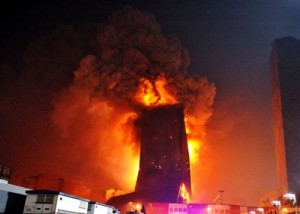
BEIJING – China’s state-run television broadcaster apologized Tuesday for an unlicensed fireworks display that sparked a blaze that destroyed a luxury hotel in the network’s headquarters complex in downtown Beijing.

The fire, which sent off huge plumes of black smoke and showered the ground with embers, left one firefighter dead and a handful of others injured, the official Xinhua News Agency said. The blaze was put out early Tuesday after burning for more than five hours at the unfinished Mandarin Oriental hotel.

Xinhua quoted Luo Yuan, a spokesman for the Beijing fire department, as saying that fireworks set off to celebrate the Lunar New Year were to blame for the fire that destroyed the nearly finished Mandarin Oriental hotel.

He was quoted as saying CCTV had hired a fireworks company to ignite several hundred large fireworks in an open area by the hotel. Video footage posted on Youtube showed spectacular bursts of fireworks above the top of the building in downtown Beijing.

“According to the Beijing fire department, this fire occurred because the person in charge of the construction of the new building project of CCTV, without permission, hired staff to set off fireworks that violated regulations,” China Central Television said in a statement on its Web site.

CCTV said it was deeply grieved “for the severe damage the fire caused to the country’s property.”

At lunch a few hours ago I was discussing with a friend the possibility of ordinary fireworks sold on the street having the force to set a skyscraper on fire. We both agreed it was more likely a professional display gone awry.

Heads are going to roll.

Update: I guess we now know why Xinhua sent out instructions last night to minimize and spin the story:

各网:“中央电视台新大楼北配楼发生火灾”相关报道,请各网站只用新华社通稿,不发图片、视频,不作深度报道;只放国内新闻区,关闭跟帖,自然滚动,论坛博客不置顶,不推荐。

To all websites: Report related to the Fire in the CCTV new building, please only use Xinhua news report. No photo, no video clip, no in-depth report; the news should be put on news area only, close the comment posts, don’t top the forum blogpost, don’t recommend posts related with the subject.

Another textbook example of CCP cover-upping.

4
Comments

Chinese online media coverage of last night’s fire

Strangest thing. China Daily, Shanghai Daily and Xinhua (to name the first ones I’ve checked) seem to have minimized mention of the Mandarin Oriental’s destruction. Go to their home pages now and see. China Daily only has a reference to the story on its list of recent articles if you look hard enough, and the story it takes you to has no photo. Xinhua had one of the earliest articles out about the fire, with photos, and that, too, has been 100 percent scrubbed from the home page, though it’s still up on their site (which is of little use if you don’t know the link).

Similarly, the CCTV-9 home page only references the fire, with no mention of the hotel name, in the list of breaking stories; no story or photo on the home page, just photos of the moon and pretty red lanterns. The link takes you to a very brief story, with photo, that does admit the fire was caused by illegal fireworks.

A spokesman for the Beijing Municipal government says initial investigations showed the fire had been caused by illegal launch of fireworks. Firefighters found remnants of fireworks on the southern roof of the burning building.

China Smack says it didn’t take long for China’s propagandistsmedia specialists to start censoring reports, locking online threads and removing photos.

Really disappointing. You’d think this would lead everywhere, and it’s ironic there’s more coverage in the international papers. As usual, this approach has to backfire, making the world wonder why the government would downplay the story and censor photos of a hotel fire. Which seems to me like an excellent question.

Update: From the hotel’s web site:

Statement in response to the fire at the development site of Mandarin Oriental, Beijing
Mandarin Oriental, Beijing was scheduled to open in the summer of 2009. The property currently employs 60 staff, all of whom work in pre-opening offices near to the hotel, which were empty at the time of the fire. Mandarin Oriental has signed a long-term contract to manage the hotel and has no ownership interest in the building. Our local management team are doing all they can to help the authorities to ensure the safety and security of everyone involved. It is too early at the present stage to assess the damage, but we will make further updates as soon as we have more information.

Update 2: Fireman dies from breathing in toxic chemical fumes while fighting the blaze.

Update 3: CCTV admits the fire was their fault; Xinhua directive on censoring/minimizing the story published.

7
Comments

Playing with fire: Mandarin Oriental Beijing destroyed

I was at the Bookworm tonight with friends, playing in the weekly quiz night (which, incidentally, we won), when the emcee told the audience that the new hotel next to the CCTV towers was in flames. We didn’t know if he was joking or not. Now I see he wasn’t joking.

From PanYi

From PanYi

The hotel is the Mandarin Oriental, and the cause was sparks caused by fireworks.

Anyone in Beijing tonight can tell you about the orgiastic explosions that rocked the city from 5pm to midnight setting off car alarms and leaving deep piles of debris on every street. Fireworks on the last night of CNY are always a very big deal here. Hastily set-up fireworks shops can be found everywhere, and they sell fireworks to people of all ages. Monitors with red armbands parade their neighborhoods to make sure people are using them safely. But something went very wrong tonight.

The Mandarin Oriental hotel caught fire sometime before 9 p.m. (1300 GMT) as the skies above the Chinese capital were filled with exploding fireworks — part of celebrations of the lantern festival that follows the Lunar New Year.

The entire hotel building was engulfed in flames, sending off huge plumes of black smoke and showering the ground below with embers. At least seven fire crews were on the scene and police held back crowds of onlookers and closed a nearby elevated highway to ensure safety.

Li Jian said he saw smoke arising from the 44-story hotel’s roof shortly after a huge burst of fireworks showered it with sparks, though it was not clear if they started the fire.

“Smoke came out for a little while but then it just started burning,” Li said….

Beijing usually tightly restricts the use of fireworks in the downtown area, but waives the rules each year during the Lunar New Year holiday. Monday, the final day of the exemption period, marked the first full moon since the Lunar New Year, and massive fireworks barrages exploded between buildings and in open spaces throughout the city.

Erik Amir a senior architect at building designers OMA said the fire had destroyed years of hard work.
“It really has been a rough six-seven years for architects who worked on this project,” said Amir, who rushed to the site after hearing of the fire.

“I think it’s really sad that this building is destroyed before it can be opened to the public,” he said.

This is right around the corner from my office; I passed by the hotel every day for nearly two years as it was being built.

So I had to ask myself: Should Beijing reconsider giving everyone the right to set off fireworks as they see fit during CNY? I’m just asking. I realize how difficult it would be to enforce a ban on fireworks when they are so much a part of the culture, and I don’t know if it would even be possible. I also don’t know whether tonight’s disaster was caused by amateurs lighting off fireworks for fun, or by a professional putting on a display for the public. I suppose we’ll find out the details soon enough.

But tonight is a reminder: fireworks can kill and destroy when they’re not used right. Should they be as freely distributed as tissue paper?

Update: Great live coverage from David Feng.

Eerily beautiful, frightening video footage here.

Update: China’s censors minimizing the story and blocking photos?

Update: CCTV admits fire was caused by their own illegal fireworks.

19
Comments

“China’s Optimistic Future”

Nice post by a Chinese American guy in Shenzhen. Some of the points may be a bit simplistic but I think it’s main thesis is pretty sound. Sorry it took me so long to find this. Via eswn.

13
Comments

Censorship Thread

I’ve been working on a freelance project the past couple of days and have several more hours to go. So the best I can do is a thread, and a link to this new article on censorship that just caught my eye. Can the party really stand up to China’s Internet community?

The Web has become a forum for public activism that would be speedily suppressed, or widely ignored, if it occurred offline. In recent months, a spate of vigilante campaigns have been waged against low-level officials accused of corruption or unseemly behavior.

In one notable case in December, an ostensibly harmless photograph of Zhou Jiugeng, a Nanjing housing official, found its way onto the Web. Sharp-eyed bloggers could not help noticing the $15,000 Swiss watch on his wrist and the $22-a-pack cigarettes on the table in front of him. Two weeks later, Mr. Zhou was fired after investigators determined that he had led an improbably lavish lifestyle for a modestly salaried civil servant.

Two weeks earlier, a Communist Party official in Shenzhen resigned after he was accused of abusing an 11-year-old girl in a restaurant bathroom. What tripped him up was a security camera video, widely circulated online, that showed him waving off the girl’s distraught family as he taunted them with his lofty rank.

Then there is the case of a Wenzhou government delegation whose publicly financed junket to Las Vegas, Niagara Falls and Vancouver was exposed by a blogger who found a bag of incriminating receipts on a Shanghai subway. After the documents were published on the Web in December, two top officials were ousted from their jobs; the other nine travelers were forced to write self-criticism essays.

None of these stories is new (except for the Shanghai extravaganza fiasco used as the story’s news hook), but the pattern and velocity is what’s interesting. Looking at the Shenzhen example, I hope the official did more than resign – he should be drawn and quartered, very, very slowly. (Disclaimer: US politicians have done some bad things, too. Yes, I know.)

This is a thread for any and all topics.

56
Comments

My Chinese New Year’s Dinner

Two nights before Chinese New Year’s Eve, I got into a lengthy conversation with a taxi driver about US politics − why we didn’t like Bush, the difference Obama would make, how it felt to have a black president, when the economic crisis would end, etc. I couldn’t go into great depth on any of these issues, just enough to get across what I wanted to, even if it was sometimes roundabout and syntactically challenged. It didn’t matter. Soon we were talking like old friends.

He was the friendliest and most loquacious taxi driver I ever had in China. As we approached my place, he asked whether I had plans for CNY’s eve, and when I said I didn’t he surprised me. “Come and have dinner with my family and me,” he said enthusiastically. I was startled as my mind quickly painted the scene: me sitting at the table with a family of total strangers for whom this is perhaps the most important day of the year; my being unable to follow the conversation quickly enough to make a meaningful contribution; my obvious presence as the only foreigner in the room making them all uncomfortable, etc.

My immediate thought was that he was just being polite, making an offer he knew I’d turn down. But another part of me felt (knew) he really meant it, that he actually would have let me into his home and greeted me as a guest. I know how important hospitality is to people here. Yet it was still hard for me to grasp that someone would go this far in demonstrating his hospitality, altering the entire mood of his family’s Spring Festival. I politely declined, although in my heart I was dying to say yes.

All my Chinese friends said the taxi driver was sincere, that I really could have walked in and they’d have treated me as a special guest, and I would have been truly welcome. I felt that I missed an opportunity, I should have said yes. How often would I have this chance to celebrate a holiday with Chinese workers in their own living place, to experience a side of Beijing life that’s still mainly foreign to me? I thought about it a lot the next day. I didn’t know I’d soon be offered something of a second chance.

The following night I went to an expat friend’s jiaozi party and was chatting with the host’s housekeeper, a gregarious fellow from the Guangdong countryside. When he asked where’d I’d be on CNY eve, I said I still wasn’t sure. With the same enthusiasm as my taxi driver’s, he said he was giving a party for his waidiren friends, guys from the countryside who didn’t have the money to go back home for Spring Festival. This time I didn’t let the opportunity slip. Yes, I said; I’ll be there. All the same doubts as with the taxi driver − language issues, a sense of intruding, putting a damper on things by sticking out − were there, exactly the same. Except this time I said to hell with it, I’m going.

Xiao Wang shares a tiny apartment up in the most northern part of Chaoyang with three roommates. He let me in to a very narrow hallway that would also be our dining room. There was a tiny little collapsible table that supported a big slab of wood, about the size of a door, which would be our dinner table. Around it were seated seven guys, each sitting on those tiny plastic stands, maybe 8 inches high. The kind where you sit down and your knees are almost hitting your face. There was no other furniture. No stereo or decorations. There was a lot of food on the table, mainly Guangdong dishes – steamed fish, taro root, grilled chicken wings, toufu, fried rice and some things I couldn’t identify.

Xiao Wang showed me his tiny room, which housed a TV set and a bed, nothing else. Instead of closets, there were plastic bags pinned to the wall to hold clothes.

Dinner was amazing. The food was excellent and somehow the initial strangeness started to fade quickly. There were two guys from Fujian, one from Heilongjiang, one from Inner Mongolia, two from Guangdong and another from – well, I don’t remember. It was probably my best night for speaking Chinese since I got here, and also one of the most relaxed, purely happy nights of the past two years.

Dinner ended, and I wasn’t sure what would follow; I thought maybe cards or mahjong. Then one of the guests brought in a pile of newspaper coupons – those bright red glossy pages that are inserted into some of the weekend papers. He handed them out and most of the guests got to work. I watched in amazement as they folded up the pages to create paper birds, dogs, little boxes and other shapes I couldn’t quite make out. One of them made a paper frog that he placed on the table. He blew at it and it jumped into the air. One of them said to me later that at their homes, their parents didn’t always have enough money to buy gifts for the Spring Festival, and they made their own toys this way.

This was probably the most unforgettable moment of the evening, watching my new friends, who probably ranged in age from 24 to 30, sit there and play with the pieces of paper, fashioning their own creations, totally absorbed in their work. It struck me how little we really need to have a wonderful time, and how people somehow manage to make do with what’s in front of them without letting their lack of physical niceties dampen their spirits.

I had to keep holding myself in check because as they started, I reflexively heard that little Orientalist voice in my head saying, “Aren’t they child-like? Isn’t this charming?” I know these people aren’t always being adorable, that they have a hard life and that what might strike me as charming and innocent is simply the way they live their life, and that if they had a choice they might be doing something else. But it was impossible not to sit in that room and watch them all working on their treasures without being moved right to the core of my being. And being the sentimental idiot I am, I felt a surge of emotion.

There is no point to this post, no conclusion or climax, no happy ending or takeaway lessons. It is simply a snapshot of what was without question one of the most beautiful and precious nights of my life. One that I know, should I ever have to leave China, I will always look back on with a pang in my heart and a renewed sense of love for the people here, and a renewed faith in the fundamental beauty of the human spirit. For a worn-out atheist like me, there was a god this Chinese New Year’s Eve, and I’ll always be grateful for the twists and turns of fate that led me to this magical occasion. Sometimes we are just lucky.
62
Comments

Technical Difficulties

As some of you know, this site has been up and down since about Friday, and comments were doing all sorts of unexpected things. That problem seems to be fixed (thanks, sir). Then, to make things totally impossible, my broadband stopped working on Friday and is still dodgy, so I’ve had only brief and intermittent access since then. Things seem to be getting back to normal; apologies for lost and/or duplicated comments and the lack of new stuff. Working on the latter.

2
Comments

New Thread

In case anyone has no place to go as the holiday winds to a close….

Something to chew on:

The global economy will slow close to a halt this year as more than $2 trillion of bad assets in the United States help sink economies from Russia to Britain, the International Monetary Fund said Wednesday.

Bank losses worldwide from toxic U.S. assets may reach $2.2 trillion, the IMF said in a report, more than the $1.4 trillion that the fund predicted in October. World growth will be 0.5 percent this year, the weakest postwar pace, the fund said in a separate report.

The reports signal that write-downs and losses at banks totaling $1.1 trillion so far are only half of what’s to come and that already contracting economies may worsen. Advanced and developing countries need to be “even more supportive” of demand than they already have been, with lower interest rates and fiscal stimulus, the lender said.

“Unless stronger financial strains and uncertainties are forcefully addressed, the pernicious feedback loop between real activity and financial markets will intensify, leading to even more toxic effects on global growth,” the IMF said.

I remember one commenter saying snarkishly, “The sky is falling!” Well, guess what?

He must feel pretty dumb today.

33
Comments

China’s upper hand

Don’t mean to sound like a broken record – I know we’ve talked about this many times. But the situation is worsening in the US and making it even more obvious than before that we’re on the verge of a new world order as America becomes, in the words of a friend I had dinner with last night, “a banana republic with nuclear weapons.” Based on the rapidly deteriorating situation in America, this merits a healthy clip:

While the rest of the world is grappling with the global slowdown, China is figuring out ways to exploit it.

Over the past few months, China has capitalized on the financial turmoil that has paralyzed the world’s “developed” economies by stocking up on cheap commodities, weeding out competition to its largest state-run companies, and acquiring even more foreign assets.

Indeed, with China’s economic growth projected at an enviable 8% for this year, that country’s government has been able to spend less time promoting immediate growth and liquidity, and more time preparing for the economic renaissance that almost certainly seems to be the Asian giant’s destiny.

By exposing Western free-market capitalism, undermining the United States economic clout, and eviscerating commodities prices, China is using the financial crisis as the perfect opportunity to advance its domestic agenda.

That agenda begins with the recently unveiled $586 billion stimulus plan – a plan primarily focused on infrastructure.

China’s financial institutions have little or no exposure to the toxic subprime assets that spawned this current global crisis. Thus, instead of having to spend hundreds of billions of dollars to bail out its banks, China can choose to develop the stage on which it will display its future economic might.

And the first phase of that plan is key: Before its plans for a massive infrastructure overhaul can be realized, China must first load up on the raw materials crucial to its execution.

We all know the impossible problems China is facing, and that 8 percent growth (which some call a rosy prediction) is a big drop that will have painful impact. We all know it’s killing its environment and repressing those citizens who can’t fight back. And we all know that the US economy is entwined with China’s, meaning more pain is inevitable. But there are differences and there are reasons why China holds an advantage for the future. The engineers at the top of the party know what they want to do and don’t have to deal with messy thing like pluralism or individual rights, so whoever gets in their way can be quickly and (relatively) easily silenced. What they want to do now is seal deals for the future, giving China more global leverage and creating a new balance of power.

We’ve been hearing about the imminent collapse of China for ten years. I was on that bandwagon in 2003. But as all the bad news keeps accumulating and everyone finds links that guarantee China has to collapse, somehow it keeps going and in some ways even gets stronger. Like in cementing its relations with Africa and exploiting the depression to make bargain-basement acquisitions that will ensure badly needed natural resources in the future. I know, I know – China’s totally fucked. But they’re less fucked than the US and Europe. And that is what will leave them in a cozy spot after the carnage is over, perhaps years from now.

Meanwhile, I hope everyone’s watching where gold has gone since I first recommended it, when it was under $650 an ounce. Think about where’d you’d be today if your 401K money had been invested differently. The dollar simply has to fall, and as the dollar falls, gold…. Please take a look at this if you still doubt. This issue is relevant to China, which is already quietly looking for other places to invest its money.

56
Comments

Interview: Lost Laowai meets the Peking Duck

The Peking Duck himself is interviewed over at Ryan’s splendid site about why/how he left the US to came to Asia, why he left Beijing early in 2003, where he went next, how he came back at the end of 2006 and whether he has plans to leave in the future. I also briefly reflect on the state of the current government and what I’d like to see it do to improve. For those of you who don’t yet know much about your host and who have nothing more important to do this weekend, please be sure and have a look. I

Thanks to Ryan, who of course helped give this site the facelift it so badly needed last year, and for providing the opportunity to share with his readers stuff I normally say little about over here. Please do have a look.

[Note, at 11.30 the next morning: I wrote this post at 4am and meant to save it as a draft, to put up in the morning. Never blog after 2am. I edited it down.]
.

5
Comments